
How to Set an Income Goal You'll Actually Hit

By Luiz King · · 10 min read

To set an income goal you'll actually hit, pick one number, the right goal type (a total you reach once, or recurring monthly income), and a deadline. Then work backwards to the small action that gets you there, like "send 5 pitches a day", and track that action daily. A goal without a daily action is just a wish with a dollar sign.
This guide walks through the six steps, shows examples for every common hustle, and covers the mistakes that make people quit.
What makes a good income goal?
A good income goal is specific, believable and connected to something you do every day. Compare:
| Weak goal | Strong goal |
|---|---|
| "Make more money online" | "$3,000 in total from freelance clients by June 30" |
| "Get rich this year" | "$1,000 MRR from my app by the end of the year" |
| "Do my best with my store" | "$5,000 in total store revenue in 6 months" |
Why bother being this specific? Because "do your best" barely works. Edwin Locke and Gary Latham reviewed 35 years of goal research and found that specific, hard goals led to better performance than telling people to do their best. "Do your best" has no finish line, so people can't tell whether they're on track (Locke & Latham, 2002).
One important exception comes up in step 6: when you're still learning the skill, a goal about learning can beat a goal about money.
Step 1: Start with why you need the money
Before picking a number, decide what it's for. That number becomes your floor: the least that makes the effort worth it.
- "Cover my bills so I can quit" → your monthly costs, plus taxes, plus a cushion.
- "Pay off a $2,400 card" → $2,400 in total.
- "Prove this hustle works" → a first milestone, like $1,000 in total.
If you're self-employed, remember taxes come out of what you earn. In the US, self-employment tax alone is 15.3%, on top of income tax (IRS). So "I need $2,000" usually means you need to earn more than $2,000.
Freelancing? Here's a detailed method for a realistic freelance income goal in your first year, with a worked example.
Step 2: Pick the right type of goal
This is the step most people skip, and it's where most goals break. There are two kinds of income goal that work:
- A total goal: "$3,000 in total". Every payment adds up until you reach it. Best for freelancing, agency projects, selling products and most beginners.
- A recurring goal (MRR): "$1,000 a month in subscriptions". MRR means monthly recurring revenue: the money that comes in every month from subscriptions or retainers. Best for SaaS, memberships and monthly clients.
What about "$1,000 every month" from a hustle where income comes in bursts? Avoid it at the start. A $600 project lands one month and nothing the next, so a monthly target fails most months even when you're making real progress. That's exactly the feeling that makes people quit in month two.
Step 3: Check your number against reality
Now sanity-check the number. Big goals are fine. Goals that ignore reality aren't, because missing them by a mile kills motivation.
Two US surveys give a good baseline for side hustles:
- In Bankrate's June 2025 survey, side hustlers earned an average of $885 a month, but the median was $200, and only 14% earned over $1,000 a month (Bankrate).
- In LendingTree's March 2026 survey, side hustlers averaged $1,242 a month, and the most common time spent was 5 to 10 hours a week (LendingTree).
So $1,000 a month puts you ahead of most side hustlers. That's not a reason to aim lower. It's a reason to start with a first milestone you can hit, then raise the bar. Here's how long it takes to make $1,000 online, path by path.
Step 4: Add a deadline and milestones
A deadline turns a number into a pace. "$3,000 by June 30" tells you how much you need each week. "$3,000 someday" tells you nothing.
Pick a deadline you'd bet a small amount on, not your dream date. Then add milestones, because the first ones are the hardest:
| Milestone | Why it matters |
|---|---|
| First $1 | Proves someone will pay you |
| First $100 | Proves it wasn't a fluke |
| First $1,000 in total | Proves the hustle works |
| Your main goal | The number from step 1 |
Each milestone is a small win you can celebrate, and small wins are what keep you going through the slow weeks.
Step 5: Turn the goal into tries
Money doesn't come from goals. It comes from sales, and sales come from tries: pitches, proposals, DMs, listings, videos.
Work backwards with three numbers:
- Sales needed = goal ÷ what one sale pays.
- Tries needed = sales needed × tries per sale.
- Tries per week = tries needed ÷ weeks until your deadline.
Here's an example. The numbers are made up to show the math:
| Step | Example: $3,000 freelance goal in 20 weeks |
|---|---|
| Price per project | $300 |
| Sales needed | $3,000 ÷ $300 = 10 projects |
| Tries per sale (a guess at first) | 1 in 8 proposals |
| Tries needed | 10 × 8 = 80 proposals |
| Per week | 80 ÷ 20 = 4 proposals a week |
Four proposals a week. That's not a scary goal anymore. That's a Tuesday.
Don't want to do the math by hand? The free money goal calculator takes your goal, price and pace and gives you the weeks and a daily task.
Step 6: Pick one daily action and plan when you'll do it
Now shrink the weekly tries into one daily task: "Send 1 proposal", "20 cold DMs", "Cut 3 clips". Then decide exactly when and where you'll do it.
This "when and where" step sounds small, but it's well studied. Researchers call it an implementation intention: an if-then plan like "When I sit down after dinner, I'll send 5 DMs before opening anything else." A review of 94 studies found these plans had a medium-to-large positive effect on reaching goals, on top of just having the goal (Gollwitzer & Sheeran, 2006).
Still learning the skill? Then make your daily action about learning, not money. Locke and Latham note that when a task is new and complex, a hard performance goal can backfire, and a learning goal ("learn 3 ways to write a cold email hook this week") often works better until you have the basics (Locke & Latham, 2002). Keep the money goal as your direction, but judge your days by what you learned and built.
Example income goals for every hustle
These match the starter templates in Money Mode. Change the numbers to fit you.
| Hustle | Example goal | Example daily tasks |
|---|---|---|
| Freelancing | $3,000 in total from clients | Send 5 proposals, follow up with 3 leads |
| Agency and SMMA | $10,000 in total agency revenue | 20 cold outreach messages, 1 sales call |
| E-commerce and reselling | $5,000 in total store revenue | Test 1 product, launch 1 ad |
| Content and clipping | First $1,000 from content | Post 1 video, cut 3 clips |
| Software and SaaS | $1,000 MRR | 1 hour building, talk to 1 user |
| Learning a high-income skill | First $1,000 from the skill | 1 hour of study, pitch 5 potential clients |
Want a deeper plan for your hustle? See how many cold DMs per day for SMMA, how many proposals it takes on Upwork, how to land a first AI automation client or a copywriting practice routine that ends in real pitches.
How to review your income goal every week
Once a week, spend 10 minutes on three questions:
- Did I do my tries? This is the only thing fully in your control. If yes, the week was a success, even with $0.
- What's my real hit rate? After a few weeks, swap your guess (1 in 8) for your real number. Then redo step 5.
- Do I need to change anything? Raise your price, improve your pitch, or add tries. Change one thing at a time.
Move the deadline if your real numbers say you have to. Changing the plan based on data isn't failure. Quitting because a made-up number didn't happen is.
Common income goal mistakes
- Copying someone else's number. A "$10k a month" goal from a YouTube video doesn't know your hours, skills or price. (Already past $10k a month? The levers change; see how to go from $10k to $100k a month.)
- Using a monthly goal for bursty income. It fails most months and makes you feel behind when you aren't.
- No daily action. You check the goal, feel bad, and do nothing. Tie it to a task.
- Judging days by income. Money lags behind effort, often by weeks. Judge days by tries.
- Setting five goals at once. One goal, one direction. Add the next one when this one's done.
If you keep falling off the daily task, the problem is usually consistency, not the goal. Here's how to stay consistent with a side hustle when you have a day job.
How Money Mode turns your goal into a daily habit
Money Mode is a free-to-start app for people making money online. You set a money goal, do one small task a day to keep your streak, and start a focus timer with one tap. It runs in your browser and installs on your phone like an app.
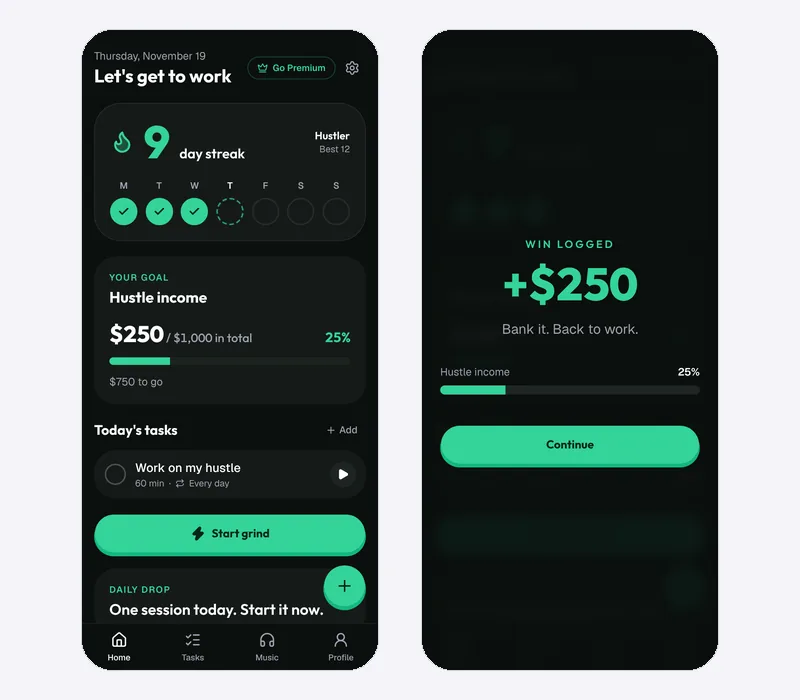
It follows the same steps as this guide:
- Step 2, the goal type: pick "in total" or "recurring (MRR)" when you set the goal, with an optional deadline.
- Step 4, the pace: with a deadline, the goal card shows how much you need per day to stay on pace.
- Step 6, the daily action: add your tries as recurring tasks, each with its own timer, and keep a streak. One finished task or 25 focus minutes counts as a grind day.
- Every win counts: log payments with the + button and watch the progress bar move.
The free plan covers one goal, the streak and up to three open tasks. Premium adds unlimited tasks, cloud sync across devices and your full history for weekly reviews, with a 14-day free trial. You can set your first money goal free in about two minutes.
FAQ
What is a realistic income goal?
One that's specific, has a deadline, and matches your price and how many hours you can work. For side hustles, the median in Bankrate's 2025 survey was $200 a month, so a first goal like $1,000 in total is realistic for most beginners and still ahead of typical.
Should my income goal be monthly or yearly?
If your income comes in bursts, like freelancing or selling products, use a total goal with a deadline instead. If customers pay you every month, use a recurring (MRR) goal. Fixed monthly targets on bursty income fail most months and push people to quit.
How do I break down an income goal?
Divide the goal by what one sale pays to get sales needed, multiply by how many tries it takes to land one sale, then spread those tries over the weeks until your deadline. That gives you a weekly number you can turn into a daily task.
How often should I review my income goal?
Once a week is enough. Check whether you did your planned tries, update your real hit rate, and change one thing if you're behind. Daily checking of income mostly creates stress, because money lags behind effort.
The short version
Pick one number, the right type (total or recurring) and a deadline. Check it against real data, add milestones, and work backwards to a weekly number of tries. Then pick one daily task, plan exactly when you'll do it, and review once a week. The goal sets the direction. The daily task gets you there.

Luiz King
Builds Money Mode, a habit tracker and focus timer made for the money grind.