
How to Stay Consistent With a Side Hustle (With a Day Job)

By Luiz King · · Updated · 7 min read

To stay consistent with a side hustle, make the daily bar so small you can hit it on your worst day, tie it to a fixed time after work, and give it about two months before you judge it. Consistency doesn't come from big weekend sprints. It comes from a tiny promise you keep every day.
Here's how to set that up, plus a weekly plan you can copy at the end.
Why is a side hustle so hard to keep going?
Nobody's checking on you. There's no boss, no deadline and no paycheck at the end of the week. You're tired after your day job, and the money from a side hustle shows up in bursts, so for weeks it can feel like nothing is happening.
So most people don't quit because they're lazy. They quit because the plan they made on a motivated Sunday doesn't survive a tired Wednesday.
The fix isn't more motivation. It's a plan that still works when you have none. (Here's why discipline isn't really about willpower.)
Set a minimum day, not a perfect day
Decide on the smallest piece of work that still counts as "I showed up today". Then follow one rule: on bad days you do the minimum, on good days you keep going.
Pick something concrete and finishable. A few examples by hustle:
| Hustle | Your minimum day | On a good day |
|---|---|---|
| Freelancing | Send 5 proposals | Follow up with last week's leads |
| Content | Cut 1 clip or post 1 video | Batch a week of posts |
| E-commerce | Test 1 product idea | Order samples for the best one |
| Building an app | 25 minutes on the product | A full 90-minute build block |
| Learning a skill | 25 minutes of study | 1 hour of study |
We built Money Mode around this idea. It's a free-to-start app for people making money online. You set a money goal, do one small task a day to keep your streak, and start a focus timer with one tap. It runs in your browser and installs on your phone like an app.
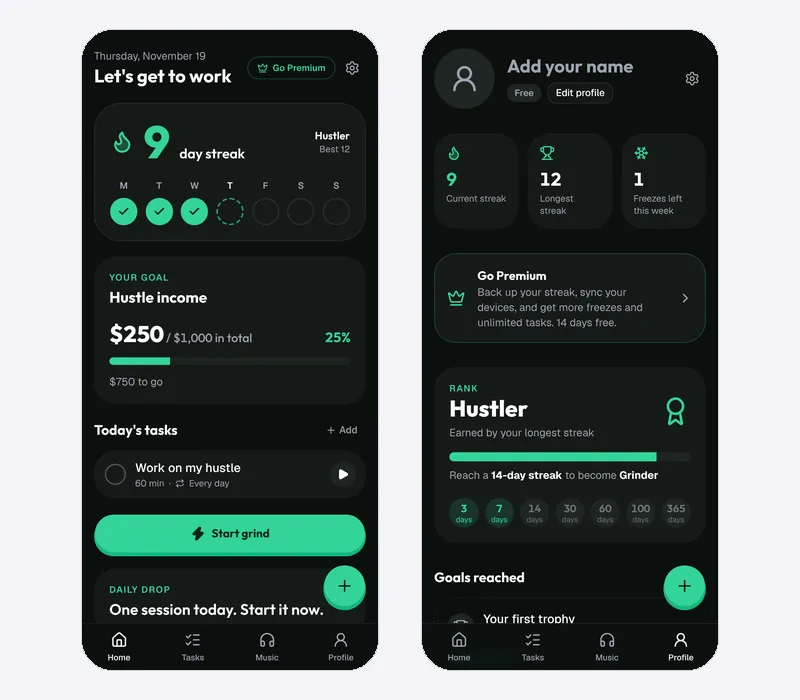
In Money Mode, a day counts as a grind day when you finish one task or focus for 25 minutes. The bar is low on purpose: low enough that you can clear it after a long shift.
Decide exactly when and where you'll do it
"I'll work on it tonight" is a wish. "When I finish dinner, I sit at the desk and send 5 proposals" is a plan.
Psychologists call this an if-then plan (the research term is "implementation intention"): when situation X happens, then I do Y. It works because the cue does the deciding for you, so you don't have to win a debate with yourself every evening.
It's one of the better-tested ideas in this space. A review of 94 studies with more than 8,000 people found that adding an if-then plan gave a medium-to-large boost to reaching goals, compared with just intending to do something (Gollwitzer & Sheeran, 2006).
Good cues are things that already happen every day:
- "When I sit back down after dinner…"
- "When I get on the train home…"
- "When I close my work laptop at 6…"
How long until it feels automatic?
Longer than the internet's "21 days", but not forever.
In a well-known study from University College London, 96 people picked a new daily habit, and 82 stuck with the study to the end. On average it took 66 days for the habit to feel automatic. But the range was huge: from 18 days to a predicted 254 days. Harder habits took longer, too. People who picked an exercise habit took about one and a half times as long as people who picked an eating or drinking habit (British Psychological Society summary of Lally et al.).
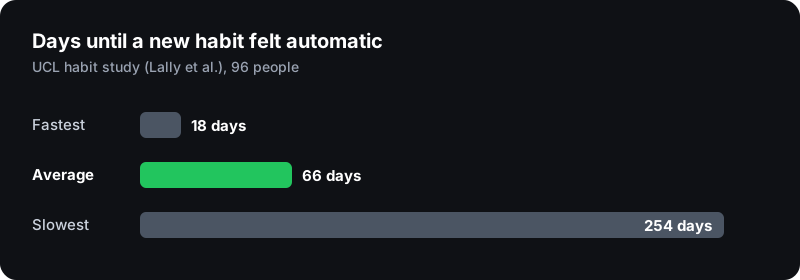
Side hustle work is closer to exercise than to drinking a glass of water. So here's a fair expectation:
The first few weeks are supposed to feel like work. That's not a sign it isn't working.
What happens if you miss a day?
Good news. In that same study, a single missed day had little effect on how the habit built up afterwards.
So one missed day isn't the problem. The problem is when one missed day turns into a "fresh start on Monday", and then Monday never comes. Treat a miss as a rest day and make the next day non-negotiable, even if you only do the minimum.
If you've already broken a streak, here's what to do after breaking a habit streak. That's also why Money Mode gives everyone one free streak freeze per week. Miss a day, and the freeze covers it, so a long streak doesn't reset to zero over one bad night.
Make your progress visible
When the money comes slowly, you need proof you're showing up. A visible streak gives you that proof.
Keep the tracking dead simple. A wall calendar where you cross off each day works. So does an app (here's how four habit trackers compare for freelancers). What matters is that you can see a chain of days and feel a little sting about breaking it.
Track the work, not just the income. Income will lag behind your effort for a while (here's how long it really takes to make your first $1,000 online). Your streak shows the effort today.
Don't burn out your day job (or yourself)
Consistency beats intensity, especially with a full-time job. A few guardrails:
- Keep work nights short. 25 to 45 minutes is plenty for your minimum. If a timer isn't keeping you focused, here's why Pomodoro might not be working.
- Save deep work for one longer block on the weekend, like 90 minutes on a Saturday morning.
- Protect sleep. A side hustle you can only run by sleeping five hours won't last. (Too tired to even start? Here's what to do when you're too tired for your side hustle.)
- If your day job starts slipping, drop to the minimum. Don't quit. Shrink.
A simple weekly plan you can copy
| Day | When | What | Time |
|---|---|---|---|
| Mon–Thu | After dinner, 7:30 pm | Your minimum task (e.g. send 5 proposals) | 25–45 min |
| Fri | Any time | Minimum only, or use your rest day | 0–25 min |
| Sat | Morning | One deep work block (client work, building, filming) | 90 min |
| Sun | Evening | Plan the week: pick tasks, check your goal | 15 min |
Adjust the times to your life (there's a fuller freelancer daily routine for people with a day job if you want one). Just keep the shape: small and daily on work nights, one big block on the weekend, and a few minutes of planning.
FAQ
How much time should I spend on my side hustle each day?
There's no magic number. With a full-time job, 25 to 45 minutes on work nights is a realistic start that you can keep up. Add one longer block on the weekend when you have the energy.
How long does it take to build a side hustle habit?
In the UCL study, a new daily habit took 66 days on average to feel automatic, with a range of 18 to about 254 days. Expect around two months, and longer for harder work.
What should I do if I miss a day?
Get back to it the next day, even with just the minimum. One missed day had little effect on habit-building in the study. Missing several days in a row is what breaks the chain.
Is it better to work every day or only on weekends?
Most people do better with a small daily task plus one longer weekend block. The daily part keeps the habit alive, and the weekend block is where the bigger work gets done.
The short version
Shrink the daily bar until it's almost too easy. Tie it to a time that already happens every day. Expect about two months before it feels normal. And when you miss a day, show up the next one.
That's how a side hustle becomes something you do, not something you keep restarting.

Luiz King
Builds Money Mode, a habit tracker and focus timer made for the money grind.