
Motivation vs Discipline: What Works When You Work Alone

By Luiz King · · Updated · 8 min read
Discipline beats motivation, but not the way the internet means it. Motivation is wanting to do the work, and it comes and goes. Discipline is doing it anyway. Research suggests the people who look most disciplined aren't white-knuckling it with willpower. They've built habits and set up their days so they face fewer temptations in the first place. When you work alone, that setup is the whole game.
Here's what the research actually says, and a simple system you can copy.
Motivation vs discipline: what's the difference?
- Motivation is how much you want to do something right now. It's high on a fresh Monday and low on a tired Thursday.
- Discipline is doing it whether you want to or not. Most people picture discipline as willpower: forcing yourself through the work by resisting the urge to quit.
- Habits and systems are the third option people forget: a routine that makes the work automatic, so you don't need much motivation or willpower at all.
| Motivation | Willpower | Habits and systems | |
|---|---|---|---|
| Feels like | "I'm fired up" | "I'm forcing myself" | "It's just what I do at 7 pm" |
| Reliable? | No, it rises and falls | Partly, but it's tiring | Yes, once it's built |
| Best for | Starting something new | Getting through a hard day | Showing up for months |
Why motivation alone doesn't last
Motivation follows how you feel, and how you feel follows your sleep, your day job, your inbox and a hundred other things. That's fine for starting. It's terrible for the 40th day in a row.
When you work alone it's worse. There's no boss, no deadline and no coworker who notices you didn't show up. Online income also comes in bursts, so you can work for weeks before anything pays, which drains motivation right when you need it.
So waiting to feel motivated is a plan that only works on good days.
Is discipline just willpower? Research says no
Here's where it gets interesting. The research on self-control doesn't support the "grind through it on pure willpower" picture.
Resisting temptation didn't predict reaching goals. In a study by Marina Milyavskaya and Michael Inzlicht, 159 first-year university students reported their temptations and self-control several times a day for a week, then reported their progress on personal goals at the end of the semester. Goal success "was influenced by experiences of temptations rather than by actively resisting or controlling those temptations." The effort of resisting was "consistently unrelated to goal attainment", and simply facing more temptations made people feel more drained (Milyavskaya & Inzlicht, 2017).
People with good self-control lean on habits. Across six studies with 2,274 people, Brian Galla and Angela Duckworth found that beneficial habits help explain why people with high self-control do better. Their conclusion: habits, "perhaps more so than effortful inhibition", are an important link between self-control and good outcomes (Galla & Duckworth, 2015).
Temptations are everywhere. In an earlier study, 205 adults carried beepers for a week and logged 7,827 moments of desire. Most desires were "largely unproblematic", but plenty clashed with what people were trying to do (Hofmann et al., 2012).
What discipline really looks like for a solo hustler
So discipline isn't a personality trait you either have or don't. It's mostly design. Four parts:
1. Make the daily bar small and clear
A vague goal ("work on my business") needs motivation to start. A small, concrete task ("send 5 proposals") just needs you to sit down. Decide your minimum day, the smallest piece of work that still counts, and only judge yourself on that. We go deeper on this in how to stay consistent with a side hustle, and for creators there's a version in how to stay consistent posting content.
2. Decide when and where in advance
Tie the task to something that already happens every day: "When I finish dinner, I sit at the desk and send 5 proposals." Psychologists call this an if-then plan. A review of 94 studies found it gave a medium-to-large boost to reaching goals, compared with just intending to do something (Gollwitzer & Sheeran, 2006).
3. Remove the temptation instead of resisting it
This is the lesson from the research above. Don't plan to resist your phone. Put it in another room. Don't plan to ignore the TV. Work somewhere else. Each temptation you remove is one fight you don't have to win.
4. Make progress visible
When money comes slowly, you need proof that you're showing up. A streak, a calendar of crossed-off days, a goal bar that moves. It turns "nothing is happening" into "I've shown up 23 days in a row".
Structure creates motivation, not the other way around
Here's the good news for low-motivation days: structure seems to help motivation, not just replace it.
In a 2023 study of 87 students, those who took breaks on a fixed schedule reported better concentration and motivation than those who took breaks whenever they felt like it (Biwer et al., 2023). The fixed structure didn't need motivation to work. It seemed to create some.
That matches how most of us actually work. You rarely feel like starting. But ten minutes into a clear task, you often feel like continuing. If the timer is where things fall apart for you, read why Pomodoro might not be working.
How long until it feels automatic?
Longer than "21 days". In a well-known study from University College London, a new daily habit took 66 days on average to feel automatic, with a huge range from 18 days to a predicted 254 days (British Psychological Society summary of Lally et al.).
So expect about two months of leaning on your system before showing up feels normal. And when you miss a day, which you will, here's what to do after breaking a habit streak.
A discipline system you can copy
| Part | What you set up | Example |
|---|---|---|
| Minimum day | One small task that always counts | Send 5 proposals, or focus for 25 minutes |
| Trigger | A fixed time and place | After dinner, at the desk, phone in the kitchen |
| Temptation plan | Remove the top 2 distractions | Phone in another room, TV off |
| Proof | A visible streak or calendar | Cross off the day as soon as you're done |
| Bad-day rule | Do the minimum, then stop | 25 minutes, even if that's all |
| Weekly check | 10 minutes on Sunday | Did the minimum work? Make it smaller if not. |
Notice what isn't on the list: motivational videos, "just push harder", or a perfect morning routine. Motivation is a bonus. The system is what you rely on.
How Money Mode turns this into a daily habit
Money Mode is a free-to-start app for people making money online. You set a money goal, do one small task a day to keep your streak, and start a focus timer with one tap. It runs in your browser and installs on your phone like an app.
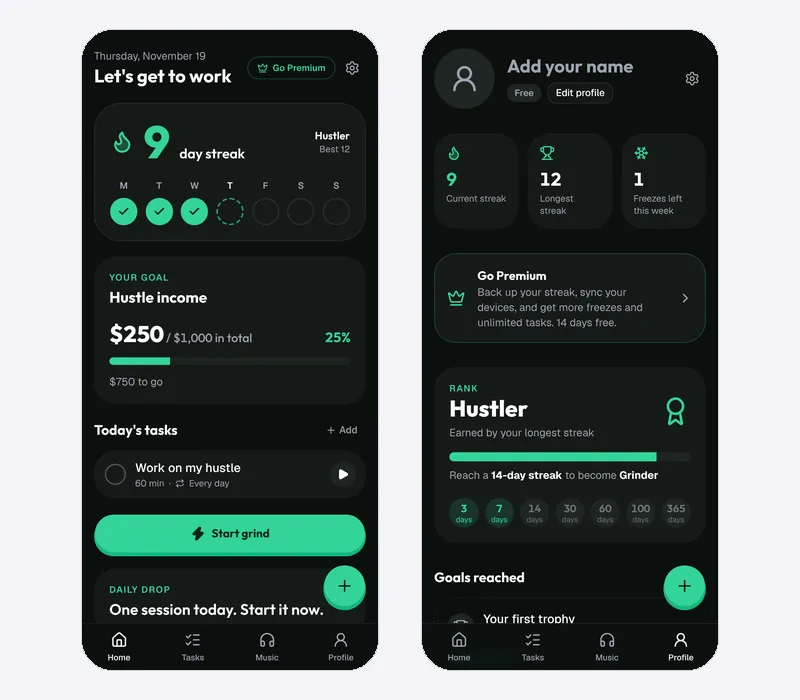
It's built around this idea: make showing up small, clear and visible, and don't depend on motivation.
- A small daily bar. A day counts as a grind day when you finish one task or focus for 25 minutes. That's your minimum day, built in.
- Clear tasks with a timer. Each task has a ▶ button, so starting is one tap, not a decision.
- Visible proof. Your streak, longest streak and calendar heatmap show the work, even in weeks when no money comes in.
- A safety net. One free streak freeze per week covers a missed day, so one bad night doesn't erase a long streak.
- Motivation as an extra. A short motivational line shows up on the home screen and at the start of a session, and you can turn the session line off. It's there to help, not to carry you.
Set your first money goal free and pick one small daily task for tonight.
FAQ
Is discipline more important than motivation?
For long-term goals, usually yes, because motivation rises and falls. But research suggests discipline works best as habits and a good setup, not as constant willpower.
How do I stay disciplined when I have no motivation?
Shrink the task until it's easy, tie it to a fixed time, remove your biggest distraction, and only aim for your minimum. Starting is often what brings the motivation back.
Can you build discipline?
Yes. Build it like a habit: repeat a small task at the same time and place. In one study, a new habit took about 66 days on average to feel automatic.
Why is it so hard to stay motivated when working alone?
There's no boss, no deadline and often no quick reward. So you have to create the structure yourself, with a fixed routine, a small daily goal and visible progress.
The short version
Motivation gets you started, but it won't show up every day. Discipline isn't about fighting harder. It's about needing to fight less: small daily tasks, a fixed time, fewer temptations and visible progress. Build that, and the work happens even on the days you don't feel like it.

Luiz King
Builds Money Mode, a habit tracker and focus timer made for the money grind.