
Pomodoro Not Working? 5 Reasons You Still Get Distracted

By Luiz King · · Updated · 8 min read

If the Pomodoro Technique isn't working for you, the 25 minutes is rarely the real problem. Most people lose focus in three places: the break turns into phone time, the task was too vague to start, or the block was too short for the kind of work they do. Fix those three and the timer starts doing its job.
I run into this myself. The timer goes off, I take my five minutes, and then I don't really come back. So here's what the research actually says, the five reasons it happens, and a routine you can copy.
What is the Pomodoro Technique, exactly?
The Pomodoro Technique is a way of working in timed blocks, created by Francesco Cirillo. Duke University's academic support center describes the classic version like this (Duke ARC):
- Set a timer for 25 minutes and work on one task.
- Take a 5-minute break, "preferably not on a screen".
- After four rounds, take a longer 15 to 30 minute break.
The same guide adds that longer blocks can also work, depending on your energy and the task. Keep that in mind, because it's the first fix below.
Does the Pomodoro Technique actually work?
Somewhat. The evidence is real but small, and most of it comes from students.
- One controlled study, 87 students: a 6-minute break after every 24 minutes of study left students less tired and less distracted than taking breaks whenever they felt like it. They also had better concentration, motivation and mood, and finished the same amount of work in less time (Biwer et al., 2023).
- A 2025 review of 32 studies (5,270 people in total) found structured intervals were linked to less fatigue and less distraction than self-paced breaks. But its author rated the certainty of the evidence "moderate to low", and the studies used very different methods (Ogut, 2025).
Reason 1: your break is a phone break
This is the big one, and it's the problem I described above.
In a Rutgers study, 414 students solved anagrams, took a short break, then solved more. Everyone did the same break task, choosing items for a shopping list, but some did it on their phone, some on paper and some on a computer (Kang & Kurtzberg, 2019). The phone group took 19% longer on the rest of the task and solved 22% fewer problems than the other break groups combined (Rutgers summary).
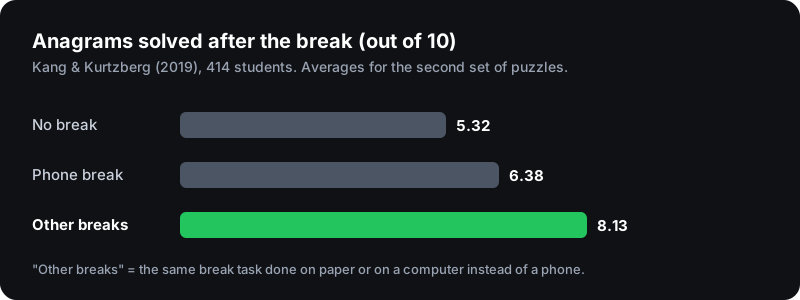
On speed, the phone group did about as badly as people who took no break at all. So a five-minute scroll isn't really a break. It's another task.
The fix: make the break physical. Stand up, refill your water, look out a window, stretch. Leave the phone face down or in another room until the next block starts.
Reason 2: you stop without knowing what's next
When the timer rings in the middle of a thought, you walk away with an unfinished task in your head. Coming back means rebuilding that thought from scratch, and that's the moment you reach for something easier.
Research backs up how sticky unfinished work is. In two experiments, organizational researcher Sophie Leroy found it's hard for people to move their attention away from an unfinished task, and their performance on the next task suffers (Leroy, 2009). Her study looked at switching between two work tasks, not at Pomodoro breaks. But the lesson carries over: a half-finished thought plus a quick check of your messages is a bad combination.
The fix: before you take the break, write down your next step in one line. "Finish the second paragraph of the proposal." "Reply to the 3 leads from yesterday." When you sit back down, you don't have to think. You just read the line and start.
Reason 3: 25 minutes is too short for your kind of work
Some work needs warm-up time. Writing, coding, editing video and designing all take a while before you're properly in it. If the timer goes off just as you get there, it can feel like Pomodoro is working against you.
Other work fits 25 minutes perfectly: outreach, email, admin and small fixes.
Match the block to the work. These are starting points to test, not research findings:
| Type of work | Try a block of | Why |
|---|---|---|
| Cold DMs, emails, admin | 25 minutes | Short tasks, easy to restart |
| Writing a proposal or a post | 45 minutes | Needs a few minutes to warm up |
| Client work, coding, video editing | 60–90 minutes | Long warm-up, costly to interrupt |
| Learning a new skill | 25–45 minutes | New material is tiring, so start shorter |
Try one length for a week before you judge it. Changing it every day just gives you something new to fiddle with.
Reason 4: the task is too vague to start
"Work on my business" isn't a task. When the timer starts on something that vague, you spend the first ten minutes deciding what to do, and deciding is exactly when distraction wins.
Make every block a concrete action with a finish line: "Send 10 cold DMs", "Edit the first 2 minutes of the video", "Write the pricing section of the proposal".
Then add an if-then plan for the restart. Psychologists call these "implementation intentions", and they're among the better-tested tools for following through. A review of 94 studies found that if-then plans gave a medium-to-large boost to reaching goals, compared with just intending to do something (Gollwitzer & Sheeran, 2006). For example: "When the break timer ends, I sit down and do the line I wrote."
Reason 5: you're waiting to feel motivated
It's tempting to think the problem is motivation. Mostly it isn't.
In the Biwer study above, the students who took breaks whenever they felt like it reported lower motivation and concentration than the ones on a fixed schedule. Structure didn't need motivation to work. It seemed to create some.
So don't wait to feel ready. Lower the bar for starting: one block, one concrete task, phone away. The feeling usually shows up after you start, not before. If you need a reason to keep showing up on bad days, see how to stay consistent with a side hustle, or what research says about motivation vs discipline.
A distraction-proof Pomodoro routine you can copy
| When | What you do | Time |
|---|---|---|
| Before the block | Write one concrete task and pick its length | 1 min |
| During the block | Phone face down or in another room. Only that task. | 25–90 min |
| When the timer ends | Write your next step in one line | 30 sec |
| The break | Stand up, water, window. No screens. Set a timer for the break too. | 5 min |
| Restart | Sit down, read the line, start the next block | Instantly |
How Money Mode helps the timer stick
Money Mode is a free-to-start app for people making money online. You set a money goal, do one small task a day to keep your streak, and start a focus timer with one tap. It runs in your browser and installs on your phone like an app.
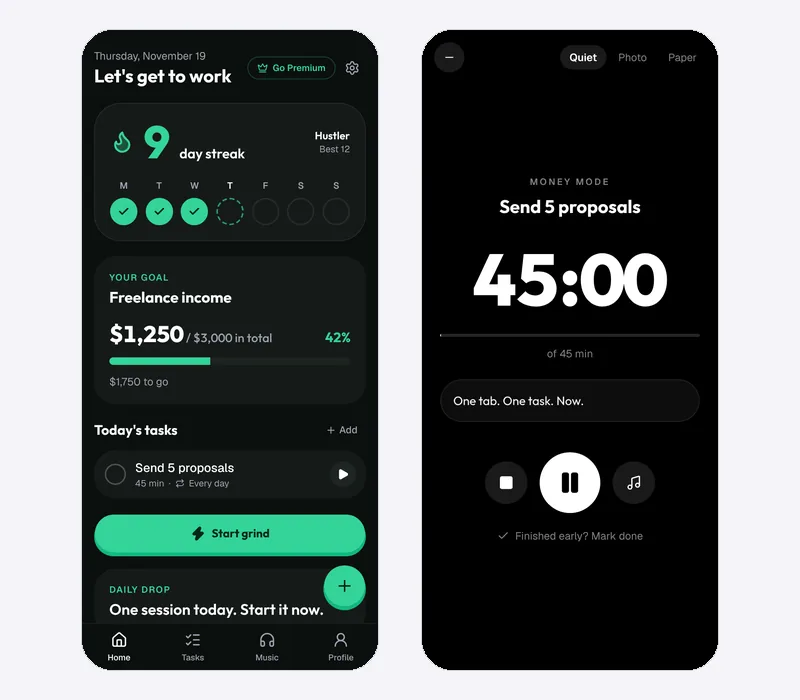
A timer on its own doesn't solve the "coming back" problem. Here's how Money Mode handles the reasons above:
- No vague tasks. Every timer starts from a task in today's list, with its own planned length. Press ▶ and the timer starts at that length, so starting the next block is one tap.
- Your block length, not ours. Pick 15, 30, 45, 60 or 90 minutes, or a custom length, per task.
- In flow when time's up? Mark the task done, add 5 or 15 minutes, or stop.
- Stopping early still counts. Your minutes are saved and the task stays open for later.
- A reason to come back. A day counts as a grind day when you finish one task or focus for 25 minutes, so one solid block keeps your streak alive.
One honest limit: Money Mode doesn't run automatic Pomodoro breaks yet. It times one block per task, so time your break with a kitchen timer or a watch, not your phone.
You can set your first money goal free and try a timed task tonight. If you want to compare it with other timer apps first, here are five to-do list apps with a timer built in.
FAQ
Why do I get distracted after a Pomodoro break?
Usually because the break was on your phone, or because you don't know what to do when you sit back down. In one study, a phone break left people slower and solving fewer problems than the same break on paper. Take breaks away from screens and write your next step before you stop.
Is 25 minutes too short for deep work?
For some work, yes. Writing, coding and editing often need longer to warm up, so try 45 to 90 minutes. Duke's study guide notes that longer blocks can also be effective, depending on the task and your energy.
Does the Pomodoro Technique actually work?
The evidence is modest. A 2023 study of 87 students found fixed breaks reduced fatigue and distraction compared with self-chosen breaks. A 2025 review rated the overall evidence as moderate to low certainty.
What should I do during a Pomodoro break?
Something physical and off-screen: stand up, stretch, get water or look outside. Set a timer for the break too, so five minutes doesn't quietly become thirty.
The short version
Pomodoro usually fails at the break, not the block. Keep breaks off your phone, write your next step before you stop, match the block length to the work, and make every task concrete. Then let the timer do what it's good at: getting you to start.

Luiz King
Builds Money Mode, a habit tracker and focus timer made for the money grind.