
How Long Does It Take to Make $1,000 Online?

By Luiz King · · Updated · 7 min read

There's no fixed timeline for making $1,000 online, and anyone who promises one is guessing or selling something. What decides it is simple: how many sales you need to reach $1,000, and how many times a week you ask for one. Selling a skill directly, like freelancing, can pay in your first month. Content and passive income usually take much longer, because platforms make you hit thresholds before they pay you.
Here's what real survey data says, the math to estimate your own timeline, and a plan to get your first $1,000.
What do side hustles actually earn?
Less than the internet suggests. Two large US surveys:
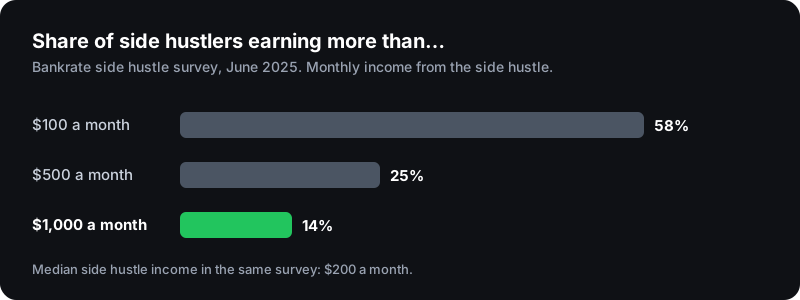
- Bankrate (June 2025, 2,616 adults): side hustlers earned an average of $885 a month, but the median was just $200 (Bankrate).
- LendingTree (March 2026, about 2,050 people): side hustlers averaged $1,242 a month. The most common time spent was 5 to 10 hours a week (LendingTree).
Why the gap between average and median? The average adds everyone up and divides, so a few people earning $10,000 pull it up. The median is the person in the middle. It's much closer to what a typical side hustler makes.
$1,000 in total or $1,000 a month?
These are very different goals, and mixing them up is why so many people quit early.
- $1,000 in total means everything you've earned adds up to $1,000. A client this week, a sale next month, another client after that. You reach it once and it's yours.
- $1,000 a month means hitting it every month. Online income comes in bursts, so you'll miss it most months at the start, even when you're making real progress.
Start with $1,000 in total. It's a goal you can actually finish, and it proves your hustle works before you ask it to pay every month. If your customers pay monthly, see MRR vs total revenue goals.
The math: estimate your own timeline
Work backwards from $1,000. Three numbers decide your timeline:
- Price: how much one sale, project or client pays you.
- Hit rate: out of every 10 tries (proposals, pitches, listings), how many turn into a sale.
- Tries per week: how many times you actually ask.
The formula: sales needed = $1,000 ÷ price, then weeks = sales needed ÷ (tries per week × hit rate).
Here's a worked example. The numbers are made up to show the math. Your price and hit rate will be different.
| Step | Example: freelance writer |
|---|---|
| Price per project | $250 |
| Sales needed | $1,000 ÷ $250 = 4 projects |
| Hit rate | 1 in 10 proposals |
| Tries needed | 4 × 10 = 40 proposals |
| Tries per week | 5 a weekday = 25 a week |
| Time to $1,000 | 40 ÷ 25 = about 2 weeks of pitching, plus the time to do the work and get paid |
Want to skip the math? Put your own numbers into our free money goal calculator and it does this for you.
Now play with it. Halve the hit rate and you need 80 proposals. Double the price and you only need 2 projects. This is why your timeline is in your hands: you can't control the market, but you can control your price, your pitch and how often you ask.
Why some paths take longer than others
| Path | How you get paid | What slows your first $1,000 |
|---|---|---|
| Freelancing (writing, design, editing) | Per project | Landing the first client with no reviews |
| Agency or SMMA (selling marketing services) | Monthly retainer | Lots of outreach before the first yes |
| Selling or reselling | Per sale | $1,000 in sales isn't $1,000 profit after costs |
| Content (YouTube, TikTok) | Ads, sponsors, products | Platforms make you reach thresholds before paying |
| Building an app or SaaS | Monthly subscriptions | Customers trickle in slowly at first |
| Learning a skill first | Nothing yet | You earn $0 until you sell the skill |
Content is the slowest by design. To earn ad revenue on YouTube, you first need 1,000 subscribers plus either 4,000 watch hours in the last 12 months or 10 million Shorts views in the last 90 days. Then YouTube reviews your channel, which it says typically takes about a month (YouTube Help). That's why many creators make their first money from a sponsor, a client or their own product instead.
A 30-day plan for your first $1,000
This plan fits around a day job. It assumes you sell a skill directly, because that's the path with the fewest gates between you and getting paid.
| Week | Focus | Daily task |
|---|---|---|
| 1 | Pick one offer and one price | 30 min: write your offer, make 1 sample of your work |
| 2 | Start asking | Send 5 pitches or proposals |
| 3 | Keep asking, follow up | Send 5 new pitches, follow up with 3 old ones |
| 4 | Deliver and ask for a review | Do the client work, then keep sending 5 pitches |
Not sure what price to pick in week 1? Here's how much to charge as a beginner freelancer. Pitching on Upwork? See how many proposals it takes to land a first client.
Two rules make this work:
- Count tries, not just income. Money lags behind effort. If you sent 25 pitches this week, that week was a success, even if nobody said yes yet.
- Show up daily, even small. Five pitches on a tired Tuesday beats a 40-pitch Sunday you never repeat. Here's how to stay consistent with a side hustle when you have a day job.
Track your first $1,000 in Money Mode
Money Mode is a free-to-start app for people making money online. You set a money goal, do one small task a day to keep your streak, and start a focus timer with one tap. It runs in your browser and installs on your phone like an app.
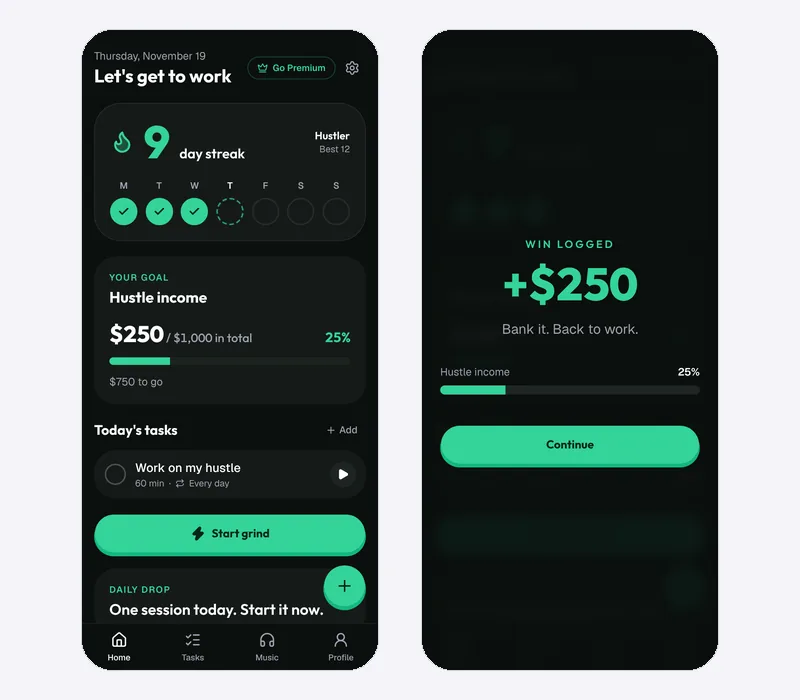
It's built for exactly this kind of goal. When you pick a hustle, the starter templates for learning a skill, content creation and "something else" all suggest a first goal of $1,000 in total. You can change the amount.
- Set the goal with an optional deadline. With a deadline, the goal card shows how much you need per day to stay on pace.
- Add your daily tries as tasks, like "Send 5 proposals" or "Follow up with 3 leads". Each has a timer if you want to work against the clock.
- Log every win with the + button and watch the progress bar move toward $1,000.
- Keep a streak. A day counts as a grind day when you finish one task or focus for 25 minutes, so the weeks with no income still show real progress.
The free plan covers all of that with up to three open tasks. You can set your first money goal free in about two minutes.
If your problem isn't the plan but sitting down and focusing, read why Pomodoro might not be working for you.
FAQ
Can you make $1,000 online in a week?
It's possible if you already have a skill, a price and people to sell to, but it isn't typical for a beginner. Treat any guarantee of $1,000 in a week as a red flag.
How much does the average side hustle make?
In Bankrate's 2025 survey, side hustlers averaged $885 a month, but the median was $200. LendingTree's 2026 survey found an average of $1,242 a month.
What's the fastest way to make your first $1,000 online?
Usually by selling a skill you already have directly to clients, such as writing, design or editing. There's no platform threshold to hit first, so the first payment depends mostly on how often you pitch.
Is $1,000 a month from a side hustle realistic?
Yes, but it's above typical. Only 14% of side hustlers in Bankrate's survey earned more than $1,000 a month. Aim for $1,000 in total first, then work up to $1,000 a month.
The short version
Your timeline to $1,000 is your price, your hit rate and how often you ask. Start with $1,000 in total, not $1,000 a month. Pick a path with few gates, count your tries every day, and let the income catch up with the effort.

Luiz King
Builds Money Mode, a habit tracker and focus timer made for the money grind.