
MRR vs Total Revenue Goal: Which Should You Track?

By Luiz King · · Updated · 6 min read

Set an MRR goal if your customers pay you every month, like subscriptions or retainers. Set a total revenue goal if they pay per job or per sale, like freelance projects or store orders. MRR tells you what you can count on next month. Total revenue tells you how much you've earned in all. Pick the one that matches how money actually reaches you.
Here's what each one means, how to count them, and how to choose.
What is MRR?
MRR (monthly recurring revenue) is the money you can expect every month from customers who pay you on repeat. Stripe defines it as "the predictable recurring income generated from customers on a monthly basis" (Stripe).
The simple formula: MRR = number of paying customers × average monthly payment.
Example: 8 customers paying $25 a month = $200 MRR.
What is total revenue?
Total revenue is everything you've earned from all sources, recurring or not. Stripe's guide describes it as revenue "from all sources, such as one-time fees, hardware sales, setup charges, and more", in addition to recurring income.
Example: a freelancer who did a $500 project in March and a $300 project in April has $800 in total revenue and $0 MRR, because neither client pays them every month.
MRR vs total revenue at a glance
| MRR goal | Total revenue goal | |
|---|---|---|
| Measures | What comes in every month, on repeat | Everything you've earned since you started |
| Best for | SaaS, memberships, retainers, agencies on monthly fees | Freelance projects, reselling, store sales, one-off gigs |
| Example goal | "$1,000 MRR" | "$3,000 in total from clients" |
| Goes down when | A customer cancels | Only if you refund someone |
| Tells you | How stable your income is | How much you've made |
How to count MRR correctly
Four rules keep your MRR honest:
- Leave out one-time payments. Setup fees, a one-off project or a single sale aren't recurring, so they don't count toward MRR. Stripe's guide lists one-time fees and setup charges under total revenue, separate from MRR.
- Turn annual plans into a monthly number. Divide the yearly price by 12. In ChartMogul's example, a $12,000 annual contract adds $1,000 to MRR each month, even though it's billed once. Paddle counts annual plans the same way (Paddle).
- Count what customers actually pay. If someone has a discount, use the discounted price.
- Take out cancelled customers as soon as they stop paying.
Example: you have 5 monthly customers at $20, 2 annual customers at $120 a year, and you charged one $50 setup fee this month.
- Monthly customers: 5 × $20 = $100
- Annual customers: 2 × ($120 ÷ 12) = $20
- Setup fee: not recurring, so $0
- MRR = $120
Which goal should you pick?
Ask one question: does the same customer pay me again next month without me selling to them again?
- Yes, mostly: track MRR. Examples: a SaaS app, a paid newsletter, social media management on a monthly retainer.
- No, mostly: track total revenue. Examples: freelance writing projects, logo design, flipping items, selling digital products once.
- A mix: pick the one you want to grow. An agency that wants stable income should track MRR, even if it also does one-off projects.
A freelancer can switch later. If you start with projects and move clients onto monthly retainers, that's a good moment to set an MRR goal.
Why not a "$1,000 every month" revenue goal?
Because online income comes in bursts. A goal that resets every month gets missed most months at the start, even when you're making progress, and that's when people quit.
So the two better options are:
- "$1,000 in total" if you're paid per job. You reach it once and keep it. Here's how long it takes to make $1,000 online.
- "$1,000 MRR" if you're paid on repeat. It grows as you add customers and holds steady between them.
How Money Mode handles both goal types
Money Mode is a free-to-start app for people making money online. You set a money goal, do one small task a day to keep your streak, and start a focus timer with one tap. It runs in your browser and installs on your phone like an app.
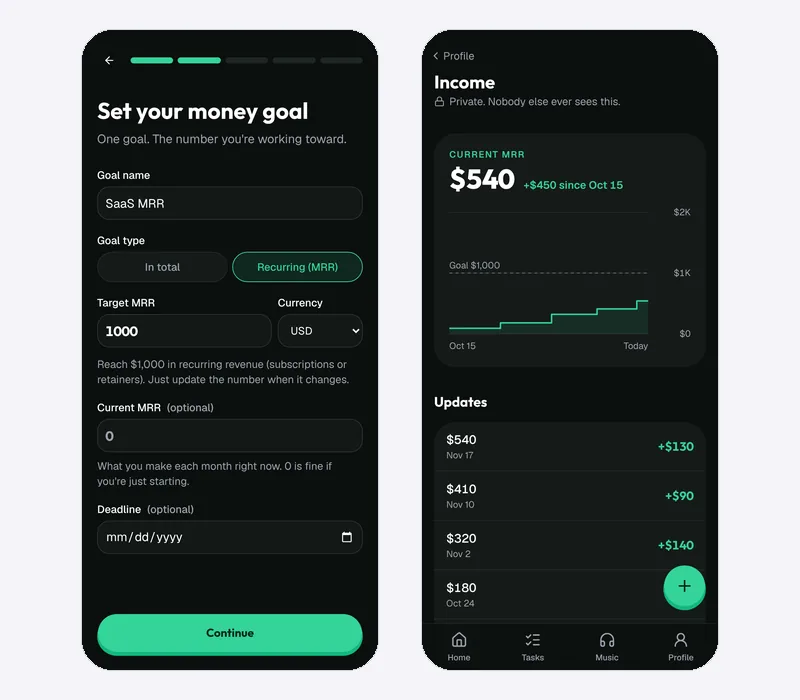
Money Mode lets you pick exactly one of these when you set your goal:
- In total: everything you log with + since the goal started adds up toward the target. You can add money you've already earned so you don't start from zero.
- Recurring (MRR): you don't log every payment. You update one number, your current MRR, whenever it changes. You can start from your current MRR.
For an MRR goal, the income screen shows your current MRR, its growth since your first update, and a step chart. MRR holds steady between updates, so the chart moves in steps, not slopes.
Money Mode keeps one goal at a time on purpose, so you always know which number you're chasing. When you reach it or switch hustles, you archive it and set the next one. The Software & SaaS template, for example, starts you with a goal of $1,000 MRR.
Set your first money goal free and choose the type that matches how you get paid. If you're counting total revenue, our money goal calculator shows how many sales and weeks it takes.
FAQ
What's the difference between MRR and revenue?
MRR is only the money that repeats every month, like subscriptions and retainers. Revenue is everything you earn, including one-time projects, setup fees and single sales.
How do you calculate MRR with annual plans?
Divide each annual plan's price by 12 and add it to your monthly total. A $120-a-year plan adds $10 to MRR.
Do one-time payments count toward MRR?
No. One-time payments like setup fees or single projects count toward total revenue, but not toward MRR.
Is MRR the same as ARR?
No, but they're linked. Stripe's guide explains that ARR (annual recurring revenue) measures recurring revenue for a full year, while MRR measures a month's worth.
The short version
If customers pay you every month, track MRR. If they pay per job, track total revenue. Count MRR honestly (no one-time fees, annual plans divided by 12), and pick one number to chase at a time.

Luiz King
Builds Money Mode, a habit tracker and focus timer made for the money grind.