
How Much to Charge as a Beginner Freelancer

By Luiz King · · Updated · 6 min read

As a beginner freelancer, charge at least your floor rate: what you need to earn per hour so the work actually pays your bills, costs and taxes. Work that out first, check it against what others in your field charge, then raise your price with each new client. Beginners usually go wrong by copying their old hourly wage or by guessing low to "get the first job".
Here's the formula, a worked example, and a simple plan for raising your rate.
Why your old hourly wage is the wrong starting point
At a job, your hourly wage comes with things you don't see: someone else pays for your laptop, your software, part of your taxes, and you get paid for every hour you're at work.
As a freelancer, none of that is true:
- You pay your own costs. Software, equipment, platform fees.
- You pay more of your own taxes. In the US, self-employed people pay 15.3% self-employment tax (12.4% for Social Security and 2.9% for Medicare), on top of income tax (IRS).
- Not every hour is paid. Writing proposals, emails, invoicing and learning all take time that no client pays for.
So the same hourly number earns you a lot less as a freelancer. That's why you start from your floor, not your old wage.
Step 1: work out your floor rate
Your floor rate is the lowest hourly price that still makes the work worth it. Three numbers:
- Monthly income you want from freelancing. What you want to take home, before tax.
- Monthly business costs. Software, tools, platform fees, equipment spread over a year.
- Billable hours per month. Hours you'll actually charge for. This is the one people overestimate. If you freelance 10 hours a week next to a job, maybe 6 to 7 of those are paid client work.
The formula: floor rate = (monthly income + monthly costs) ÷ billable hours. Then add a buffer for taxes.
Here's a worked example. The numbers are made up to show the math:
| Step | Example: part-time freelance designer |
|---|---|
| Monthly income wanted | $1,000 |
| Monthly business costs | $60 (software and tools) |
| Billable hours a month | 28 (about 7 a week) |
| Floor before tax | ($1,000 + $60) ÷ 28 = about $38 an hour |
| Tax buffer | Set aside part of every payment for tax. In the US, self-employment tax alone is 15.3%, before income tax. |
Step 2: check it against the market
Your floor tells you what you need. The market tells you what clients expect. Look at what freelancers with a similar skill and experience charge on the platforms you use, and on the websites of freelancers in your niche.
Then compare:
- Your floor is below the market: good. Price near the market, not at your floor.
- Your floor is above the market: you either need more billable hours, a narrower and more valuable niche, or lower costs. Don't just work below your floor and hope.
If you sell on a platform, remember its fee comes out of your price. Upwork's freelancer service fee, for example, is 0% to 15% per contract (Upwork).
Step 3: quote per project, not just per hour
Clients usually care about the result, not your hours. So turn your hourly floor into a project price:
project price = estimated hours × your rate, plus a buffer for revisions and back-and-forth.
| Project | Your estimate | At $40 an hour | Quote with a 20% buffer (rounded) |
|---|---|---|---|
| 3 social posts with captions | 3 hours | $120 | $145 |
| One landing page design | 8 hours | $320 | $385 |
| A 1,500-word blog post | 5 hours | $200 | $240 |
These are examples to show the math. Your hours and rate will be different.
Per-project pricing has a nice side effect: as you get faster, you keep the time you save. Hourly pricing punishes getting better.
Should beginners charge less to get the first client?
A little lower, sometimes. Way lower, no.
A small first-client discount can help you get a review and a portfolio piece. But very low prices attract clients who only care about price, and it's hard to raise your rate with the same client later. If you do discount, say so out loud: "My normal price is $240. For my first three clients it's $180 in exchange for a review." Then the real price is anchored.
Never go below your floor. Below your floor, every new client makes your month worse, not better.
Step 4: raise your rate on a schedule
Don't wait to "feel ready". Raise your price on a simple rule:
- Every new client pays a bit more than the last one, for example 10% more.
- When you're busy, that's the market telling you you're cheap. Raise it.
- Existing clients get notice before an increase, such as a month.
How your price changes your timeline
Price is the fastest lever on how long it takes to hit a money goal. Charge $240 instead of $120 and you need half as many clients to reach the same number.
Try it in our free money goal calculator: put in your goal, your price per project, how many proposals it takes to land one, and how many you'll send a week. Then change the price and watch the weeks drop. If you're on Upwork, here's how many proposals it takes to land a first client.
Track the goal and the work in Money Mode
Money Mode is a free-to-start app for people making money online. You set a money goal, do one small task a day to keep your streak, and start a focus timer with one tap. It runs in your browser and installs on your phone like an app.
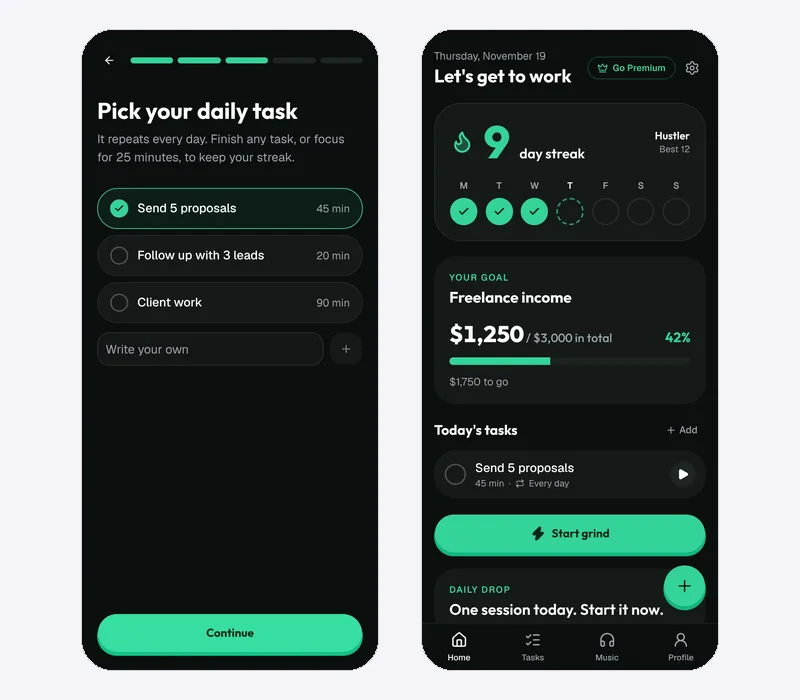
Once you've set a price, the work is showing up every day to find clients. In Money Mode:
- Set one money goal, like "$3,000 in total from clients", with an optional deadline. With a deadline, the goal card shows how much you need per day to stay on pace.
- Add daily tasks like "Send 5 proposals" or "Follow up with 3 leads", each with a timer.
- Log every payment with + and watch the bar move.
The free plan includes all of that with up to three open tasks. Set your first money goal free.
FAQ
What is a good hourly rate for a beginner freelancer?
It depends on your skill, niche and costs, so there's no single right number. Start from your floor rate, which is your income plus costs divided by your billable hours, then check it against what similar freelancers charge.
Should I charge hourly or per project?
Per project is usually better once you can estimate the work. Clients see a clear price, and you keep the benefit when you get faster.
How do I raise my rates as a new freelancer?
Charge each new client a bit more than the last, raise your price when you're fully booked, and give existing clients notice before an increase.
Do freelancers pay more tax?
In the US, self-employed people pay a 15.3% self-employment tax for Social Security and Medicare, on top of income tax. Rules differ by country, so check with a tax professional.
The short version
Find your floor, check the market, quote per project and raise your rate with every new client. Your price is the biggest lever you have on how fast you reach your money goal.

Luiz King
Builds Money Mode, a habit tracker and focus timer made for the money grind.