
Freelancer Daily Routine With a Day Job (Copy This)

By Luiz King · · 6 min read

A freelancer daily routine with a day job works best when it's small and fixed: one short work block on weekday evenings, one longer block on the weekend, three tasks at most per session, and a firm stop time. Your day job already takes the best hours, so build the routine around the time you actually have.
Below is a schedule you can copy, plus the rules that make it hold up.
Why most freelancer routines don't fit a day job
Most routines you'll find online are written for full-time freelancers. They assume a free morning, a deep-work block at your peak hours and room to rearrange your day.
You don't have that. You have an evening, tired, and a weekend with other plans. So skip the "5 am club" advice and design around real gaps. (If you struggle with energy after work, here's what to do when you're too tired for your side hustle.)
The weekday schedule to copy
This is an example for someone with a standard 9 to 5. Move the times to fit your life, but keep the shape.
| Time | What | Length |
|---|---|---|
| 6:45 pm | Dinner and a real break (no work, no phone) | 45 min |
| 7:30 pm | Start ritual, then your 1 big task | 25–45 min |
| 8:15 pm | Two small tasks (replies, admin, follow-ups) | 15–20 min |
| 8:40 pm | Stop. Write tomorrow's 3 tasks | 5 min |
| 10:30 pm | In bed, so you can get enough sleep | — |
Weekend: one 90-minute block for client work or building (Saturday morning is a good default), and a 15-minute plan for the week on Sunday evening.
That adds up to roughly 5 to 7 hours a week of side hustle work. Not a lot, but done every week it adds up. To see what that could mean for your own goal, put your numbers into the free money goal calculator.
Rule 1: Three tasks per session, not a to-do list
The Freelancers Union has a rule that fits a short evening well: pick three goals for the workday, one big task and two smaller ones (Freelancers Union, 2015).
For a freelancer, that might look like:
- Big: send 5 proposals (or finish the client deliverable)
- Small: reply to 2 messages
- Small: update your portfolio with one new piece
Do the big one first, while you still have some energy. If you only finish that, the night counts. (Here's how many proposals to expect before your first Upwork client, so your big task has a real number behind it.)
Rule 2: Start with a ritual
The same Freelancers Union article suggests a short, repeatable start ritual to cue your brain to focus. The author's own example is coffee, instrumental music and reading the news for 15 to 20 minutes before she begins.
Make yours shorter. Something like: sit at the same spot, put your phone in another room, open your task list, start the timer. The point is that the same few steps signal "work time", so you don't have to talk yourself into it.
Rule 3: Use breaks if your block is longer than 45 minutes
The Freelancers Union author uses a "45/15" method: 45 minutes of work, then a 15-minute break. It's one freelancer's method, not a law of nature.
On a weeknight you'll often only have one block, so you may not need a break at all. On your longer weekend block, a short break helps. (If breaks turn into scrolling, here's why Pomodoro might not be working.)
Rule 4: End the night on purpose
The article also says to give your workday a definite end. With a day job, this matters even more, because a side hustle that creeps into every spare hour will burn you out.
So set a stop time and write tomorrow's 3 tasks before you close the laptop. Then you start the next evening already knowing what to do.
Two more guardrails:
- Protect sleep. The CDC says adults aged 18 to 60 need 7 or more hours of sleep a night (CDC, page dated May 2024). If your routine needs less than that, shrink the routine.
- Check your day job's rules. Some employment contracts limit outside work, and using your employer's time or equipment for a side hustle can put your job at risk. Read your contract and keep the two separate.
How Money Mode runs this routine
Money Mode is a free-to-start app for people making money online. You set a money goal, do one small task a day to keep your streak, and start a focus timer with one tap. It runs in your browser and installs on your phone like an app.
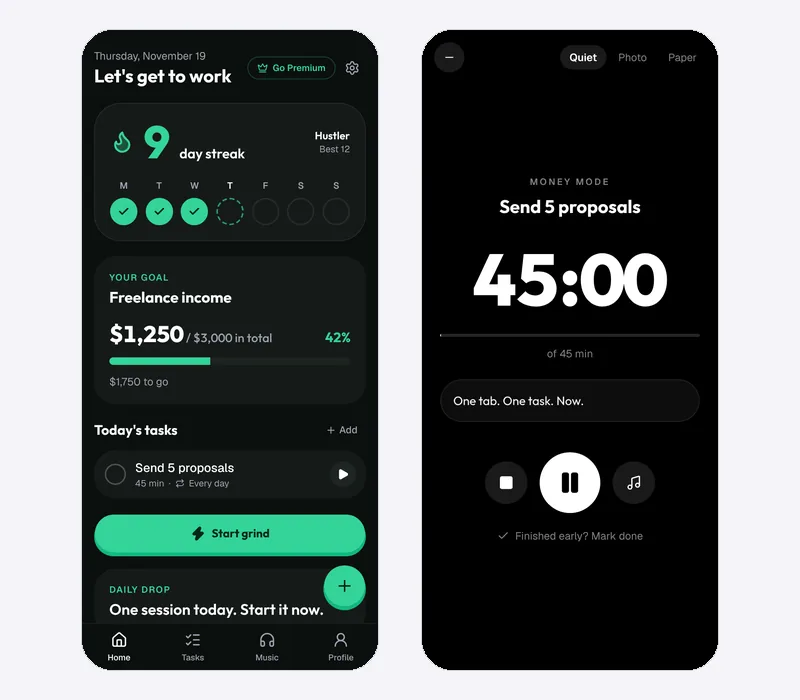
Add your three tasks, give each a time, and press play on the big one. A grind day counts when you finish one task or focus for 25 minutes, so even a short night keeps your streak going. The free plan includes up to 3 open tasks at once, which matches the 3-task rule above.
You can set your first money goal free and put tonight's tasks in. When your routine grows past 3 open tasks (a second client, a weekly report, a learning block), Premium has no task limit, and you can try it free for 14 days.
FAQ
How many hours a week can I realistically freelance with a full-time job?
It depends on your job and energy. The schedule above comes to roughly 5 to 7 hours a week. Start there, keep it for a few weeks, then adjust. If your day job starts to slip, cut back.
Should I freelance in the morning or the evening?
Whichever slot you can keep every day. Mornings can be easier if you have energy, evenings if your mornings are packed. Pick one, tie it to a cue and don't change it for a few weeks.
How do I stop freelance work from taking over my evenings?
Set a stop time, write tomorrow's tasks and close the laptop. A fixed end is what keeps a small routine small.
What if I only have 30 minutes a day?
Use the schedule's first two rows: one ritual, one big task. Thirty focused minutes on the right task, repeated every day, adds up. You can always add the weekend block later.
The short version
Build around the time you actually have. Use one big task and two small ones, a short start ritual, a firm stop time and enough sleep. Keep the weekday small and put the deeper work in one weekend block. Then repeat it until it's boring. Boring is what a freelance side income looks like in the early months.

Luiz King
Builds Money Mode, a habit tracker and focus timer made for the money grind.