
How to Get Your First AI Automation Client (30-Day Plan)

By Luiz King · · 7 min read

To get your first AI automation client, stop selling "AI automation" and sell one fix for one type of business. Pick a niche, pick one boring problem they have (like leads nobody follows up on), build one working demo, and pitch 5 businesses a day with a short message that shows it. Most of the 30 days goes on outreach, not on learning more tools.
Below: the 30-day plan, a message template you can copy, and what to charge first.
Why most beginners never land the first client
They keep learning. Another course, another tool, another agent tutorial. It feels like progress, but no business owner ever paid for "I know n8n".
Business owners pay for results: fewer hours spent on data entry, faster replies to leads, no more missed invoices. Your job is to turn a tool into one of those results, then tell enough people about it.
Step 1: Pick one niche and one problem (days 1–3)
Pick a type of business you can reach and understand: dental clinics, real estate agents, e-commerce stores, recruiting agencies, accountants. Then pick one problem that wastes their time every week.
Good first problems are boring and easy to measure:
| Niche | Boring problem | What your automation does |
|---|---|---|
| Real estate agents | New leads wait hours for a reply | Instant reply and a booking link for every new lead |
| Small e-commerce stores | Order questions fill the inbox | Auto-answers to "where's my order?" |
| Accountants | Collecting client documents by email | A form that files uploads and sends reminders |
| Agencies | Copying form leads into the CRM | Leads go straight into the CRM with a Slack alert |
"I help real estate agents reply to every new lead in under a minute" is a pitch. "I build AI automations" isn't.
Step 2: Build one demo (days 4–10)
Build the automation for your chosen problem once, end to end, with fake data. Record a 2-minute screen video of it working. That video is your portfolio.
You don't need to spend money to start:
- Make has a free plan with 1,000 credits a month (Make pricing).
- n8n has a free Community edition that you host yourself (n8n docs).
Pick one and stick with it. Switching tools halfway through is an easy way to lose a week.
Step 3: Pitch 5 businesses a day (days 8–30)
Start outreach before the demo is perfect. Five well-researched messages a day is about 100 messages over the month, enough to learn what works.
A message template you can copy
Hi [name], I noticed [specific thing: you reply to Zillow leads by hand / your contact form says "we reply in 48 hours"]. I build small automations for [niche] that [result: reply to every new lead within a minute]. Here's a 2-minute video of one working: [link]. Want me to sketch how it would work for [business name]? No charge for the sketch.
Why it works: it's about them (a specific detail), it shows proof (the video), and it asks for something small.
Where to send it
- LinkedIn: good for B2B niches. Keep invitations personal. If you hit LinkedIn's invitation limit, your account can be restricted from sending invitations, and LinkedIn says this typically lasts one week (LinkedIn Help). Five thoughtful messages a day won't get you near it. Mass automation might.
- Email: if you email US businesses, follow the CAN-SPAM Act. It covers business-to-business email too: no misleading subject lines or headers, include your physical address and a clear way to opt out, and honor opt-outs within 10 business days. Each violating email can cost up to $53,088 in penalties (FTC CAN-SPAM guide). Other countries have their own rules, so check where your leads are.
- People you already know: a first client can come from someone who already trusts you. Tell your network what you now do.
For a deeper look at outreach volume and follow-ups, see how many cold DMs per day to send. The numbers there are for agencies, but the logic is the same.
Step 4: Turn a "yes" into a small paid pilot
When someone says "interesting", offer a small, fixed-price first project: one automation, a clear result and a clear price. Small is easier to say yes to, and it gets you a case study.
What should you charge? There's no standard price, and online claims vary a lot. Think about what the problem costs the client each month and price well below that. For a framework on beginner pricing, read how much to charge as a beginner freelancer.
What's realistic?
Be wary of anyone promising a client in a week. Here's one public, self-reported example: a member of an AI automation community posted a month-6 update with 5 active clients, $3,200 in monthly recurring revenue and about 20 hours of work a week, and wrote that they weren't quitting their day job yet (Skool post, month 6). It's one person's numbers in a course seller's community, not a typical result. But it shows the honest shape: months, not days, and steady work alongside a job.
The 30-day plan at a glance
| Days | Focus | Daily task |
|---|---|---|
| 1–3 | Niche and problem | Research 10 businesses in your niche |
| 4–10 | Demo | 1 hour building, then record the video |
| 8–30 | Outreach | Pitch 5 businesses with a personal message |
| 8–30 | Follow up | Follow up with anyone who hasn't replied in 3–4 days |
| Every Sunday | Review | Count messages, replies and calls. Change one thing |
How Money Mode keeps the 30 days on track
Money Mode is a free-to-start app for people making money online. You set a money goal, do one small task a day to keep your streak, and start a focus timer with one tap. It runs in your browser and installs on your phone like an app.
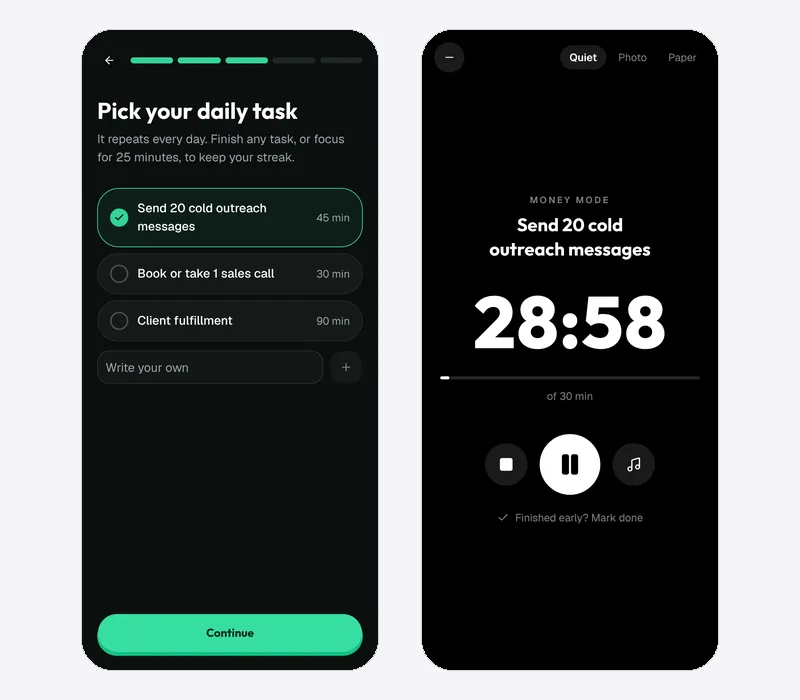
When you pick "learning a high-income skill" during setup, Money Mode suggests a "first $1,000 from the skill" goal and daily tasks like "1 hour of study", "build 1 portfolio piece" and "pitch 5 potential clients". That's this plan. A grind day counts when you finish one task or focus for 25 minutes, so your streak shows whether you're actually pitching, not just learning.
Set your first money goal free. The free plan allows 3 open tasks at once, which fits the three suggested tasks. Want to add follow-ups as a fourth daily task? Premium removes the limit, with a 14-day free trial.
FAQ
Do I need to be an expert to get my first AI automation client?
No, but you need one thing working well. A single solid demo for one problem is enough to start pitching. Be honest about your experience and offer a small first project.
Should I do free work to get my first client?
A free sketch or short audit can open a conversation. Building full automations for free usually doesn't lead to paid work. Offer a small paid pilot instead, so the client has skin in the game.
Which niche is best for an AI automation agency?
The one you can reach and understand. A niche where you have contacts or past work experience beats a "hot" niche where you know nobody. Pick one and give it at least a month of outreach before switching.
How many messages does it take to get a first client?
There's no reliable average. It depends on your niche, offer and message. Track your own numbers for a month: messages sent, replies and calls. Then use them in the free money goal calculator to see how long your goal could take.
The short version
Pick one niche and one boring problem. Build one demo and record it. Send 5 personal messages a day, follow up, and offer a small paid pilot when someone is interested. Expect it to take months, not days, and track what you do so you can see what's working.

Luiz King
Builds Money Mode, a habit tracker and focus timer made for the money grind.