
Realistic Freelance Income Goal for Your First Year

By Luiz King · · 7 min read

A realistic first-year freelance income goal sits between two numbers: your floor (what the work has to pay to be worth it) and your ceiling (your price times the hours you can actually bill). Set your goal for the year below the ceiling, because the first months go into finding clients. For most side hustlers, that means aiming for a total like $1,000 to $5,000 in year one, not a monthly salary.
Below is real data on what side hustlers earn, a four-step method to set your own number, and a worked example you can copy.
What do freelancers really make in their first year?
There's no reliable survey of first-year freelancers only. But surveys of side hustlers in general are a good reality check:
- Bankrate (June 2025, 2,616 US adults): side hustlers earned an average of $885 a month, but the median was $200. Only 14% earned more than $1,000 a month (Bankrate).
- LendingTree (March 2026): side hustlers averaged $1,242 a month, and the most common time spent was 5 to 10 hours a week (LendingTree).
The median is the person in the middle, so it's closer to typical than the average, which a few big earners pull up. So if you make less than $1,000 a month in your first year, you're not failing. You're normal.
Step 1: Find your floor
Your floor is the least the freelancing has to bring in for it to be worth doing. It answers "what does this need to cover?"
- Side hustle: the costs of the hustle itself (software, platform fees, equipment), plus whatever extra you're working for, like $300 a month toward a debt.
- Full-time: your monthly living costs plus business costs.
Then add taxes on top. In the US, self-employed people pay 15.3% self-employment tax on top of income tax (IRS). If you expect to owe $1,000 or more for the year, you generally need to pay estimated tax during the year, not just at the end (IRS). Tax rules depend on where you live, so check your own country's rules or ask a tax pro.
Step 2: Find your ceiling
Your ceiling is the most you could earn if every billable hour were full:
Ceiling = your price per hour × billable hours per week × weeks you work
"Billable" is the key word. Not every work hour gets paid. Pitching, emails, invoices and learning all take time. As a beginner, a big share of your hours goes into finding clients, so be honest about how many you'll actually bill.
Don't know your price yet? Here's how to work out what to charge as a beginner freelancer.
Step 3: Set a goal that ramps up
Your first months won't look like your last. Early on you're building samples, pitching and waiting for replies. Later you have reviews, repeat clients and referrals. So plan the year in stages instead of dividing by 12.
Here's a worked example for a side hustler. The numbers are made up to show the method. Use your own.
| Item | Example: freelance designer, side hustle |
|---|---|
| Price | $30 an hour |
| Hours a week on freelancing | 10 |
| Billable hours a week (once busy) | 6 |
| Ceiling for 48 weeks | $30 × 6 × 48 = $8,640 |
| Year-one goal (well below the ceiling) | $4,000 in total |
And here's how that $4,000 might ramp across the year:
| Quarter | What you focus on | Example income |
|---|---|---|
| Q1 | Samples, pitching, first client | $300 |
| Q2 | More pitching, first reviews | $700 |
| Q3 | Repeat clients, raise your price | $1,200 |
| Q4 | Referrals, fuller weeks | $1,800 |
Notice that Q1 is small on purpose. If you expect $1,000 in month one and get $100, you'll quit. If you expected $300 in the first three months, $100 in month one is on track.
Step 4: Turn the goal into weekly tries
A yearly number doesn't tell you what to do on Tuesday. Tries do. Money comes from sales, and sales come from pitches, proposals or DMs.
Work backwards: sales needed = goal ÷ price per project, then pitches needed = sales × pitches per sale. With $4,000, $200 projects and 1 sale for every 10 pitches, that's 20 projects and about 200 pitches over the year, or about 4 a week.
Want this worked out for your own numbers? Put them into the free money goal calculator. It gives you the sales, the tries, the weeks and a daily task.
Should your goal be yearly, monthly or in total?
For year one, use one total for the year, like "$4,000 in total from freelancing by next November". Freelance income comes in bursts: a $600 project one month, nothing the next. A monthly goal fails most months at the start even when you're on track, and that's what pushes people to quit.
If you sell retainers (clients who pay every month), a recurring goal can make more sense. Here's MRR vs total revenue goals, explained simply.
Not sure about the bigger picture? Our main guide covers how to set an income goal for any hustle, step by step.
How Money Mode tracks a first-year goal
Money Mode is a free-to-start app for people making money online. You set a money goal, do one small task a day to keep your streak, and start a focus timer with one tap. It runs in your browser and installs on your phone like an app.
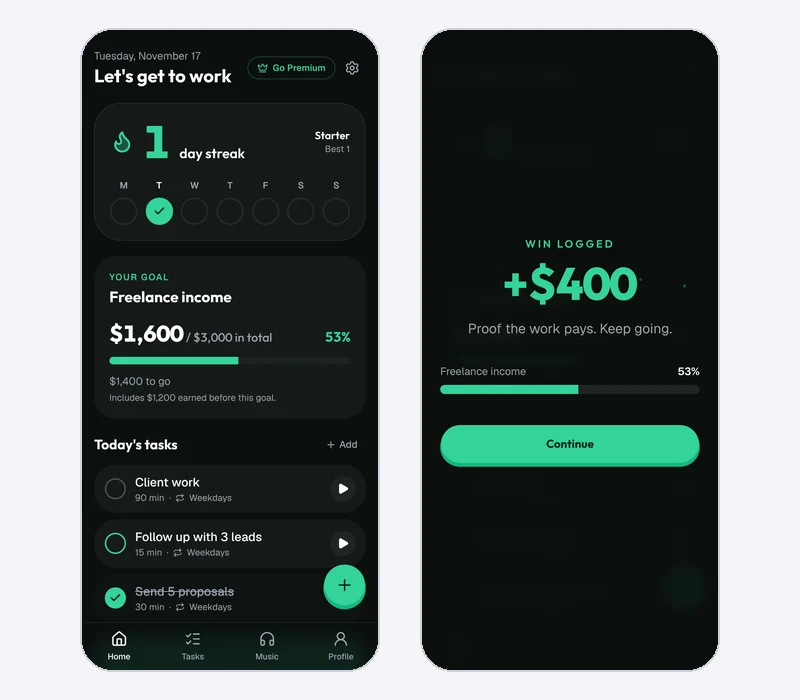
It's built around exactly this kind of goal:
- Set one total goal with a deadline, like $4,000 by next November. The goal card shows how much you need per day to stay on pace.
- Add your weekly tries as daily tasks, like "Send 5 proposals", each with its own timer.
- Log every payment with the + button and watch the bar move, even in the slow months.
The free plan covers the goal, the streak and up to three open tasks. Looking back over a whole year (every week's work and income) is part of Premium's full history, with a 14-day free trial. You can set your first money goal free in about two minutes.
FAQ
How much should I make in my first year of freelancing?
There's no standard number. In Bankrate's 2025 survey, the median side hustler earned $200 a month, and only 14% earned over $1,000 a month. Set a goal between your costs and what your hours allow, and plan for slow early months.
Is $100k realistic in your first year of freelancing?
For most beginners, no. It needs a high price and nearly full billable weeks from early on, which most new freelancers don't have yet. A smaller first-year goal you can beat is a better start than a big one you abandon.
How many hours a week do freelancers really bill?
Fewer than they work, because finding clients, admin and learning aren't paid. Track your own billable hours for a month and use that number, not a guess. Here's how many hours a day to put into a side hustle.
Should I set a monthly or yearly freelance income goal?
Yearly or "in total" for year one. Freelance income comes in bursts, so a monthly target fails most months at the start, even when you're on track.
The short version
Set your first-year freelance goal between your floor (costs plus taxes) and your ceiling (price × billable hours), and stay well below the ceiling. Plan a slow start, use one total for the year, and turn it into weekly pitches. The median side hustler makes $200 a month, so a goal you can beat is a real win.

Luiz King
Builds Money Mode, a habit tracker and focus timer made for the money grind.