
How Many Hours a Day Should You Work on a Side Hustle?

By Luiz King · · 7 min read

If you have a full-time job, aim for about one focused hour on most days, plus one longer block at the weekend. That's roughly 6 to 8 hours a week. It's small enough to keep up for months, and that matters more than any single big day. If one hour is too much right now, start with 25 minutes and grow from there.
Below: where that number comes from, how to adjust it to your life, and a weekly plan you can copy.
Is there a "right" number of hours?
No. Ask ten people and you get ten answers. On the Side Hustle School podcast, the host describes listeners putting in anything from one hour a week to 25 hours a week or more (Side Hustle School, episode 1981).
So the real question isn't "how many hours is correct?" It's "how many hours can I keep doing every week without wrecking my sleep or my day job?"
How much free time do you actually have?
Less than it feels like. The US Bureau of Labor Statistics measures how people spend their days. In 2025, employed people spent an average of 4.17 hours a day on leisure and sports, and almost 2 hours of that (1.98) was watching TV (BLS American Time Use Survey, Table 11A).
That's an average across every day of the week, weekends included. On a workday you probably have less.
Here's what that means for a side hustle:
| Daily side hustle time | Share of an average 4.17 free hours |
|---|---|
| 25 minutes | About 10% |
| 1 hour | About 24% |
| 2 hours | About 48% |
| 3 hours | About 72% |
One hour a day means giving up about a quarter of your free time. Two hours means half of it. That's why so many people start with a burst of 3-hour nights and quit by week three.
Why one focused hour beats three distracted ones
Most side hustle time isn't lost to too few hours. It's lost inside the hours: checking your phone, picking a task, re-reading yesterday's work.
Computer scientist and author Cal Newport points out that few people can keep peak focus for more than an hour or so without a break (Cal Newport, "On Deep Breaks"). After a full day at work, your tank is even emptier.
So one hour with a clear task and a timer often gets more done than three hours of "working on my business" with the TV on. If you keep losing focus mid-block, here's why Pomodoro might not be working for you.
How to find your own number in 3 steps
Step 1: Protect your sleep first
The CDC says adults aged 18 to 60 need 7 or more hours of sleep a night (CDC). Work backwards from your alarm. If you wake at 7 am, the side hustle ends by 11 pm, not 1 am.
Step 2: Pick a weekday floor and a weekday target
- Floor: the minimum that still counts on a bad day. For most people this is 20 to 25 minutes.
- Target: what you do on a normal day. For most people with a 9-to-5, this is 45 to 60 minutes.
Write both down before the week starts. On tired nights you do the floor, not nothing. (Here's a full minimum-day plan for tired nights.)
Step 3: Add one long weekend block
Some work needs a long stretch: building a website, recording videos, a big client project. Put that in one 2-to-3-hour weekend block instead of squeezing it into weeknights.
A weekly plan you can copy
This example adds up to about 7 hours a week. Change the times to fit your life, not the other way round.
| Day | Time | What you do (example: freelance writer) |
|---|---|---|
| Mon–Thu | 7:30–8:30 pm | 1 hour on one task: pitch 5 clients, or write one draft |
| Fri | Off | Rest. Planned rest isn't quitting. |
| Sat | 9:00–11:30 am | One long block: finish client work, build the portfolio |
| Sun | 15 min | Plan next week: pick one task per weekday |
Notice there's a day off. People who never plan rest end up taking it anyway, just at random, and then feel like they've failed.
For a full day-by-day version for freelancers, see this freelancer routine for people with a day job.
When should you work more than an hour a day?
Add time only when three things are true:
- You've kept your current routine for at least 3 to 4 weeks.
- You're still sleeping 7+ hours.
- Your day job isn't suffering.
If all three hold, add 15 to 30 minutes a day, not two hours. Then check again in a month.
How long will it take at an hour a day?
That depends on your goal, your price and how many tries it takes to make a sale. Put your numbers into the free money goal calculator and it shows how many weeks your goal could take at your weekly pace. It shows the math, not a promise. For a realistic picture of the first milestone, here's how long it takes to make $1,000 online.
How Money Mode helps you keep your hour
Money Mode is a free-to-start app for people making money online. You set a money goal, do one small task a day to keep your streak, and start a focus timer with one tap. It runs in your browser and installs on your phone like an app.
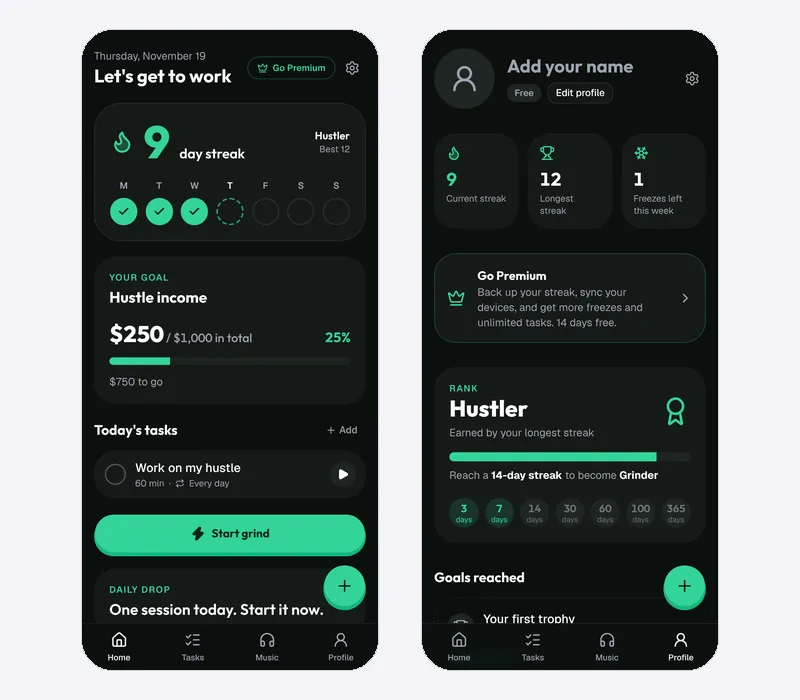
It's built around the floor-and-target idea. A grind day counts when you finish one task or focus for 25 minutes, so your 25-minute floor keeps your streak alive on tired nights. Your full hour simply adds more minutes. The free plan includes one streak freeze a week for the day you miss anyway.
You can set your first money goal free and start tonight's hour with one tap. The free plan includes up to 3 open tasks at once. If your week has more moving parts than that, Premium removes the limit and adds 3 freezes a week, with a 14-day free trial.
FAQ
Is one hour a day enough for a side hustle?
Yes, for most people starting out. One focused hour on most days adds up to 6 to 8 hours a week, which is enough to send pitches, make content or build a small product. Doing it every week matters more than doing more.
How many hours a week should a side hustle take?
There's no standard. People put in anything from one hour to 25 or more a week. With a full-time job, 5 to 10 hours a week is a sustainable range for most people. Start at the low end and add time only after a few steady weeks.
Should I work on my side hustle in the morning or at night?
Pick the time you can protect most often. Mornings work if you can go to bed early. Evenings work if you rest first. The best slot is the one you can keep 4 or 5 days a week.
Is it bad to work on a side hustle every day?
Not if the daily amount is small and you sleep enough. But plan at least one rest day a week. Planned rest keeps the routine going; burnout ends it.
The short version
Aim for one focused hour on most weekdays, a 25-minute floor for bad days, and one longer weekend block. Keep it for a month before adding more. The number of hours matters less than whether you can still keep it up in week twelve.

Luiz King
Builds Money Mode, a habit tracker and focus timer made for the money grind.