
How to Go From $10k to $100k a Month (Stage by Stage)

By Luiz King · · 7 min read

To go from $10k to $100k a month, you need three things: an offer priced so the math works (about 100 customers at $1,000 a month, not 10,000 at $10), a growth rate of roughly 10% a month (which gets you there in about two years), and a new job description at each stage, because the work that got you to $10k is what keeps you stuck there.
This post breaks all three down with the real math, a stage-by-stage table and a weekly plan you can copy. No guarantees here: these are the levers, not a promise.
Why do businesses get stuck at $10k a month?
Because $10k a month is about as far as one person doing everything can go. You sell, you deliver, you answer support, you do the books. Every new client adds hours, and you only have so many.
The stuck feeling usually isn't a lack of effort. It's that your hours are full. Scott Oldford put it bluntly in Entrepreneur: to scale "from $20,000 per month to $100,000, you cannot be an entrepreneur — you have to evolve into a CEO." In plain words: you stop being the person who does the work and become the person who builds the machine that does it.
Step 1: Do the customer math first
$100k a month is a price times a number of customers. Pick the combination before you pick the tactics:
| Price per customer per month | Customers you need | What that feels like |
|---|---|---|
| $10 | 10,000 | A consumer app. Needs huge reach. |
| $100 | 1,000 | A SaaS tool or membership |
| $1,000 | 100 | A premium service or B2B product |
| $10,000 | 10 | A high-ticket agency or consultancy |
| $100,000 | 1 | One giant client. Fragile. |
Dan Martell makes the same point in his $100K/month breakdown: "Land about 100 customers at $1,000 each and you're at $100K a month." He argues for the middle of the table. Big enough that you don't need viral reach, spread enough that losing one client doesn't sink you.
Step 2: Know the growth rate you need
How fast do you need to grow? Here's the plain compounding math for going 10x, from $10k to $100k a month:
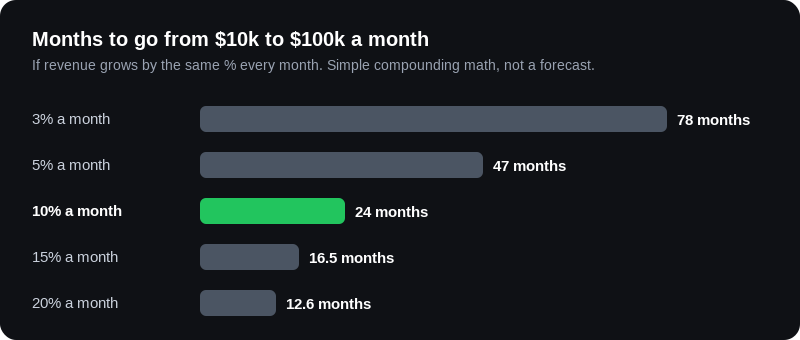
The difference between 5% and 10% a month isn't double the speed. It's 47 months versus 24, nearly two years saved.
For a sense of scale: Paul Graham wrote in Startup = Growth that "a good growth rate during YC is 5-7% a week." That's for very early startups growing from tiny numbers, so don't hold yourself to it at $10k a month. But it shows that 10% a month is a reasonable target, not a fantasy.
How to find your own growth rate
Take this month's revenue, divide by last month's, and subtract 1. $11,000 ÷ $10,000 − 1 = 10%. Do it for the last 6 months and average it. If your average is 2%, the chart tells you that what you're doing now will take over a decade to reach $100k. Something has to change.
Step 3: Change your job at each stage
Here's how the work shifts between $10k and $100k a month. This is our framework, based on the "operator to CEO" idea above, not a law. Treat the numbers as rough:
| Stage (per month) | Your main job | First hire or system | Trap to avoid |
|---|---|---|---|
| $10k → $25k | Raise prices, sharpen the offer | A delivery checklist (SOP) | Taking every client who says yes |
| $25k → $50k | Sell; hand off delivery | Someone who delivers the work | Doing the work "faster myself" |
| $50k → $75k | Build a repeatable lead source | A second person in sales or marketing | Relying on referrals alone |
| $75k → $100k | Manage the managers and the numbers | Weekly metrics review | Becoming the bottleneck for every decision |
Notice the pattern. Every stage is about removing yourself from one more job.
Step 4: Track the inputs, not just the revenue
Revenue is a result. It shows up weeks after the work that caused it. If you only watch revenue, you'll always react too late.
Pick the two or three inputs that drive revenue in your business and do them every day:
| Business | Daily inputs that drive revenue |
|---|---|
| Agency | 20 outreach messages, 1 sales call, 90 minutes of client work |
| SaaS | 1 hour building, talk to 1 user, 1 marketing post |
| E-commerce | Test 1 product, launch 1 ad, answer all support tickets |
| Consulting | 5 warm follow-ups, 1 piece of content, 1 proposal |
The first three rows are Money Mode's built-in starter tasks for those hustles. They're starting points; edit them to fit your business.
Track your $100k goal and daily pace in Money Mode
Money Mode is an app for people making money online. You set one money goal, log your revenue, and do one daily task to keep your streak. It runs in your browser and installs on your phone like an app.
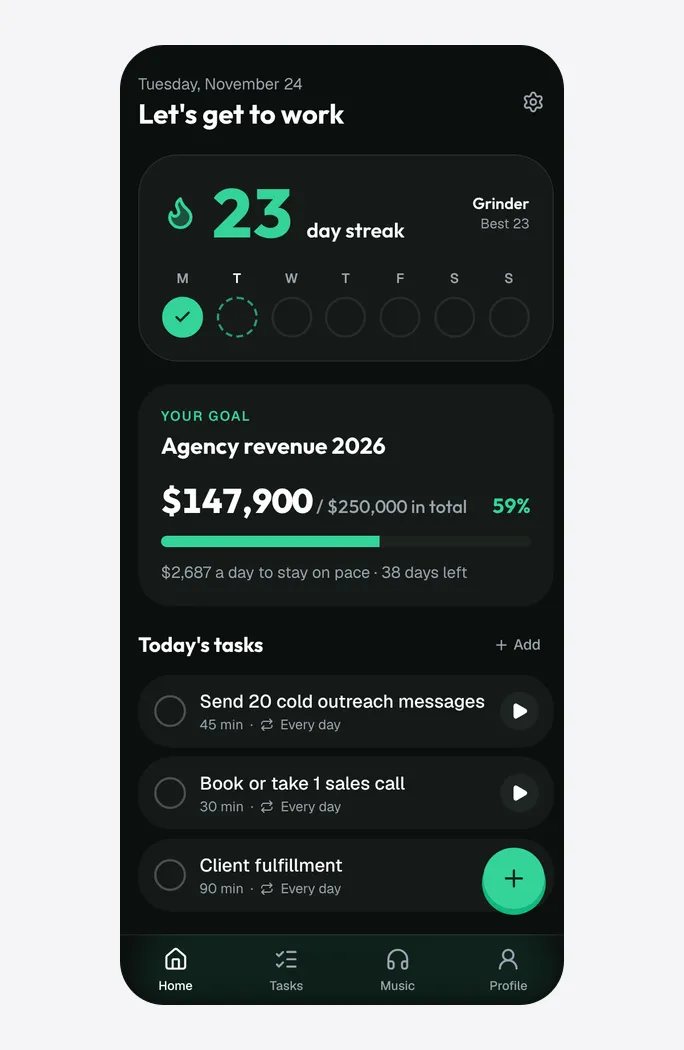
For the $10k-to-$100k climb, set it up like this:
- Pick the goal type. "Recurring (MRR)" if your revenue is subscriptions or retainers. "In total" if it's projects and sales. (Not sure? Here's how to choose.)
- Set your next milestone, not the final one. $25k a month is easier to believe in than $100k, and you'll set the next goal when you hit it.
- Add your daily inputs as recurring tasks. One finished task, or 25 minutes of focus, counts as a grind day.
- Log every payment. The goal card shows how much a day you need to stay on pace.
It's free to start. Set your $100k goal free and see your daily pace in two minutes.
A 12-week plan to get off the $10k plateau
Copy this. Adjust the numbers to your business:
| Weeks | Focus | Done when |
|---|---|---|
| 1–2 | Do the customer math. Pick your price point. | You can say "X customers at $Y" |
| 3–4 | Raise prices for new clients by 20–30% | 3 new clients said yes at the new price |
| 5–6 | Write delivery checklists for your main service | Someone else could deliver it from the doc |
| 7–8 | Hire or contract your first delivery person | You've handed off one client fully |
| 9–10 | Spend the freed hours on sales | Your daily outreach task has a 10-day streak |
| 11–12 | Review: growth rate, margins, what to fix next | You've set your next milestone |
FAQ
How long does it take to go from $10k to $100k a month?
At a steady 10% monthly growth, about 24 months. At 5%, about 47 months. At 3%, over six years. Your own growth rate is the number to know.
What's a realistic growth rate for a $10k/month business?
There's no universal number. Measure your last 6 months first. If it's under 3% a month, change the offer or the sales process rather than working more hours.
Should I hire before I reach $25k a month?
For delivery, often yes, once your hours are full. A first contractor can cost less than the sales you miss while you're busy delivering. Keep it to one role you've already written down as a checklist.
Is it easier to raise prices or get more customers?
Raising prices usually comes first, because it grows revenue without adding hours. Use the money goal calculator to see how a new price changes the number of sales you need.
The short version
$100k a month is math: a price, a number of customers and a growth rate. Fix the price first, aim for about 10% a month, and remove yourself from one job at every stage. Then do the daily inputs every day. The revenue follows the work, weeks later.

Luiz King
Builds Money Mode, a habit tracker and focus timer made for the money grind.