
Deep Work for Founders When Everything Is on Fire

By Luiz King · · 7 min read

Deep work for founders isn't about finding a quiet week. It never comes. It's about sorting real fires from smoke in 10 seconds, pushing everything else into two short "ops windows" a day, and guarding one 90-minute block every morning like it's a meeting with your biggest client. Most "fires" can wait two hours. The work that grows the business can't wait forever.
This post gives you the fire test, the daily schedule, and the setup that makes it stick. If you're new to the idea, start with what deep work is, then come back.
Why founders never get deep work
Because a founder's job is to be interruptible. Customers, team, investors and partners all have a direct line to you. And the numbers on interruptions are brutal for everyone, not just founders:
| Finding | Source |
|---|---|
| People are interrupted every 2 minutes during core work hours (275 times a day) | Microsoft Work Trend Index, 2025 |
| 57% of meetings are ad hoc calls with no calendar invite | Same report |
| 50% of meetings land between 9–11 am and 1–3 pm, when many people are most productive | Same report |
| It takes about 25½ minutes to get back to an interrupted project | Gloria Mark, UC Irvine |
Put those together and the math is ugly. If something pulls you away every few minutes and it takes 25 minutes to get back, you never get back.
Step 1: The 10-second fire test
Before you leave a deep work block for anything, ask two questions:
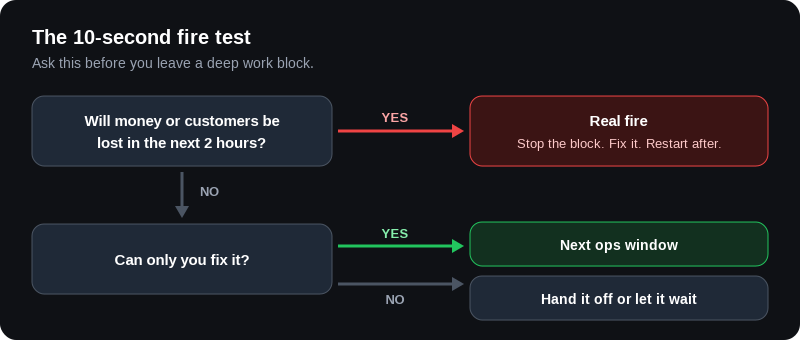
Here's how common "fires" sort out:
| What happened | Real fire? | Where it goes |
|---|---|---|
| Checkout is broken; no one can pay | Yes | Stop and fix now |
| Your biggest client is threatening to cancel today | Yes | Call them now |
| A teammate asks how to do a task | No | Next ops window, or they check the doc |
| An investor emails "quick question" | No | Next ops window |
| A bug that affects 2% of users | Usually no | Ops window; hand it off if you can |
| A Slack thread you're tagged in | No | Ops window |
Real fires are rarer than they feel. That doesn't mean ignoring them. It means making sure only real ones can reach you during the block.
Step 2: Create a fire lane
People ping you because it's the only way they know. Give them a better one:
- One emergency channel. Tell your team and key clients: "If something is really on fire, call me. Everything else, send a message and I'll answer by noon."
- Phone on Do Not Disturb, with exceptions. Most phones can let calls from favorite contacts through. Add your cofounder, your top clients and whoever handles your site.
- Close Slack and email during the block. Not minimized. Closed.
- Set your status. "Deep work until 10:30. Call if urgent." People respect a time they can see.
Step 3: Batch everything else into ops windows
An ops window is a fixed time to handle all the reactive stuff at once: email, Slack, small bugs, approvals. Two a day is enough for most founders:
| Time | Block | What happens |
|---|---|---|
| 8:00–9:30 | Deep work | The one task that moves your money goal. No inbox. |
| 9:30–10:15 | Ops window 1 | Clear messages, sort fires from last night, unblock the team |
| 10:15–12:30 | Meetings and calls | Sales, 1:1s, customer calls |
| 13:30–15:00 | Second deep work block (optional) | Writing, building, planning |
| 15:00–15:45 | Ops window 2 | Everything that came in since morning |
| 15:45–end | Meetings, admin, review | Close loops, plan tomorrow |
If 90 minutes feels impossible right now, start with 45. A shorter block you protect beats a long one you never get. Our guide on how long a deep work session should be helps you size it.
Step 4: Decide the task the night before
The quickest way to waste a deep work block is to spend the first 20 minutes deciding what to do. Pick it the evening before, and pick the task that most moves revenue:
- Agency owner: write the pitch for your biggest prospect.
- SaaS founder: ship the feature that three customers asked for.
- Creator: script the next video.
- Consultant: finish the client proposal that closes this week.
If you can't name it, the block becomes email by default.
Step 5: Protect the block with a streak
Willpower fades. A streak doesn't argue. Here's how Money Mode helps. It's an app for people making money online: you set one money goal, add the daily tasks that move it, and start a focus timer with one tap. It runs in your browser and installs on your phone like an app.
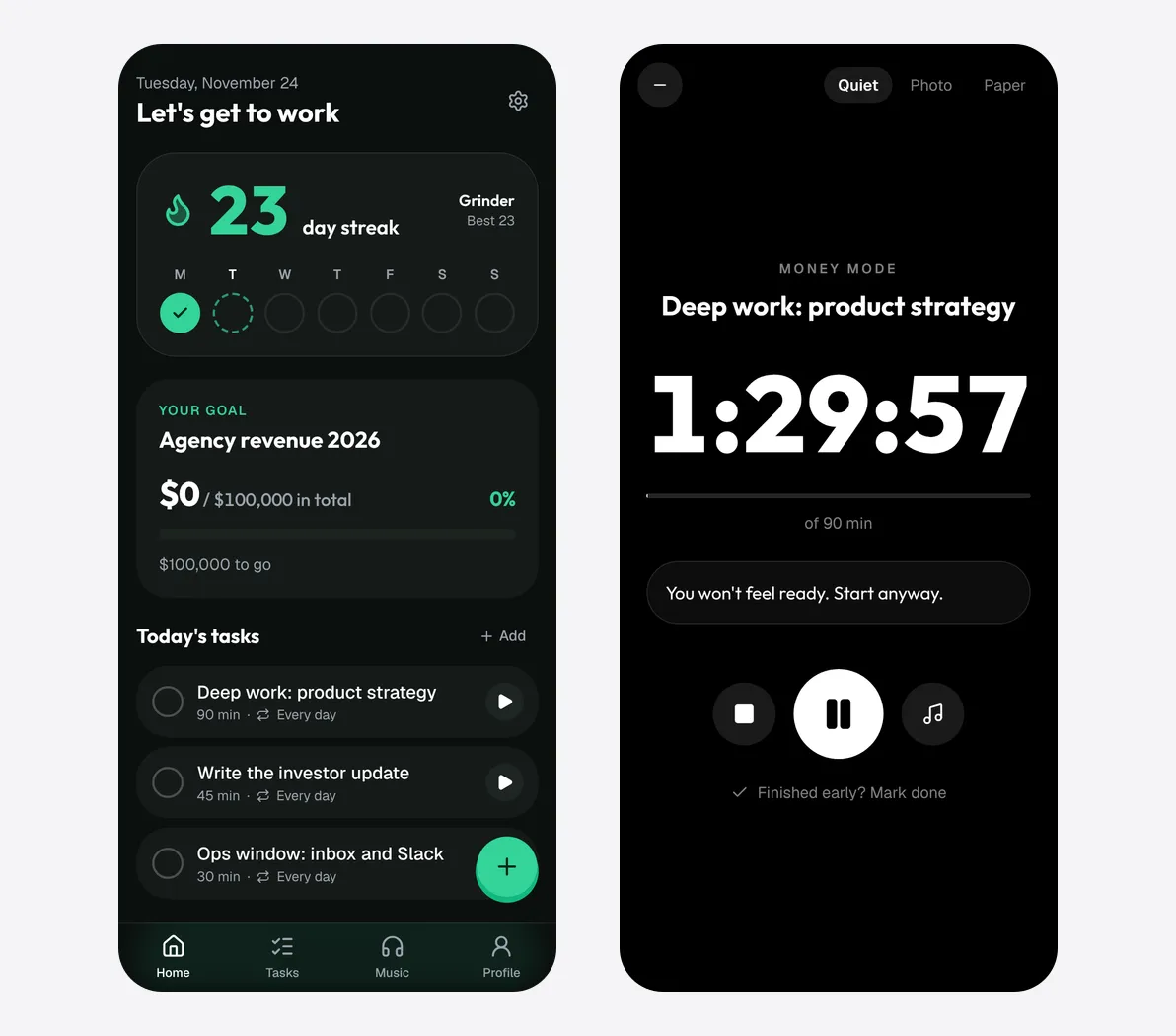
Set it up like this:
- Add "Deep work: [your task]" as a daily task with 90 minutes (or 45 to start).
- Add "Ops window" as a second daily task with 30–45 minutes, so reactive work has a clear end.
- Tap play when the block starts. The timer fills the screen, so your inbox is out of sight.
- Finishing one task, or 25 focus minutes, counts as a grind day. Even on a day when a real fire eats the afternoon, your morning block keeps the streak alive.
The free plan holds 3 open tasks at once, enough for deep work, an ops window and one sales task. Set your first money goal free and start your first block tomorrow morning.
What to do when a real fire hits mid-block
It will happen. Here's the drill:
- Write one line about where you stopped ("halfway through pricing section, next: annual plan").
- Fix the fire. Fully. Don't half-fix it to rush back.
- Restart the block, even for 25 minutes. A short block still counts, and the note gets you back in fast.
FAQ
How much deep work should a founder do per day?
Aim for one 90-minute block on most days, or 45 minutes if you're starting out. One protected 90-minute block, five days a week, adds up to 7.5 hours of your best work. For the bigger picture of planning a week, see time management for CEOs.
Is it irresponsible for a founder to go offline for 90 minutes?
Not if real emergencies can still reach you. Set up one emergency channel (a phone call), tell people about it, and let everything else wait for your ops window.
What if my team keeps interrupting me?
Interruptions usually mean people are blocked. Hold office hours in your ops windows, write down the answers you keep giving, and share the doc. The questions drop fast.
Should founders do deep work in the morning?
For most people, yes, before messages pile up. But pick the time you're sharpest and can protect. The key is that it's the same time every day.
The short version
Things will always be on fire. Most of it is smoke. Use the 10-second fire test, give real emergencies one lane, batch everything else into two ops windows, and protect one block a day for the work that grows the business.

Luiz King
Builds Money Mode, a habit tracker and focus timer made for the money grind.