
What Is Deep Work? A Plain Guide for Side Hustlers

By Luiz King · · 6 min read

Deep work is focused work on a hard task with zero distractions: no phone, no inbox, no tabs you don't need. Computer scientist Cal Newport made the term popular in his 2016 book Deep Work, which describes it as the ability to focus without distraction on cognitively demanding tasks. For anyone making money online, it's the part of the day that actually makes money.
This guide explains what deep work is (and isn't), why it's getting rarer, Newport's four rules in plain words, and how to fit deep work around a day job.
Deep work, defined simply
Deep work is hard, focused work done without switching to anything else. The publisher's description of Newport's book calls it "the ability to focus without distraction on cognitively demanding tasks" (Hachette Book Group).
Two parts matter:
- Hard: it stretches your skills. Writing a sales page, coding a feature, editing a video, planning an ad campaign.
- Undistracted: one task, start to finish of the block. Checking Slack "just quickly" ends it.
Easy work done with full focus isn't deep work. Hard work done with your phone buzzing isn't either.
Deep work vs shallow work
The opposite of deep work is shallow work: tasks you can do while half-distracted. They feel productive, but they rarely move your income on their own.
| Deep work (examples) | Shallow work (examples) |
|---|---|
| Writing a client proposal or a sales page | Answering routine emails and DMs |
| Building a product feature | Moving tasks around in your to-do app |
| Editing a video or writing a script | Scrolling for "content ideas" |
| Planning your offer and pricing | Tweaking your profile picture or logo |
| Learning a hard skill with practice | Watching another "how to make money" video |
Shallow work isn't bad. Invoices need sending. The problem is when shallow work fills every free hour and the deep work never starts.
Why deep work is getting rarer
Screens pull our attention in short bursts. Gloria Mark, a professor at UC Irvine, has measured how long people stay on one screen before switching for over 20 years. In her first study, from 2003, the average was two and a half minutes. In studies from 2016 to 2020, it was 47 seconds (UC Newsroom, 2024).
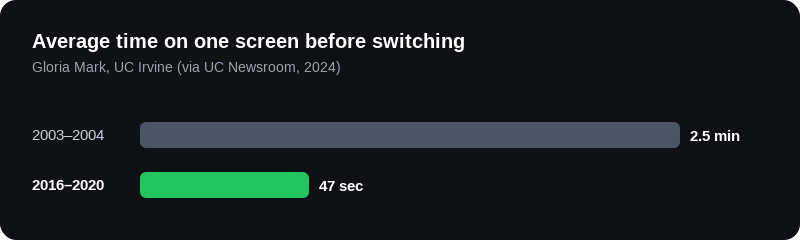
Two more findings from the same interview stand out. Getting back on track after an interruption can take almost half an hour. And about half the time, we interrupt ourselves; no notification needed. If you run a business and the interruptions come from clients and a team, see how founders protect focus when everything is on fire.
So if you can hold focus on one hard task for an hour, you're doing something most people around you can't. That's why it pays.
Newport's four rules, in plain words
The book is organized around four rules (Hachette Book Group). Here's what each one means for a side hustler:
- Work deeply. Don't wait for focus to show up. Schedule deep work at a set time, in a set place, with a set start routine.
- Embrace boredom. If you grab your phone every time you're bored for 5 seconds, your brain forgets how to stay on one thing. Practice waiting in line without your phone.
- Quit social media. Newport's point is to be choosy: keep only the tools that clearly help you. For many hustlers, social media is the job, so set a time for posting and close the app after.
- Drain the shallows. Cut, batch or shrink shallow tasks so they don't eat your best hours. Answer messages twice a day, not 40 times.
How much deep work do you need?
Less than you think. Newport suggests taking 2 to 4 hours of your day for maximum focus (Cal Newport). He also writes that few people can keep peak focus for more than about an hour without a break (Cal Newport).
With a full-time job, one focused block of 45 to 90 minutes on a work night is a strong day. For session lengths, breaks and how to build up, read how long a deep work session should be.
Deep work with a day job: a 90-minute evening plan
Here's an example of one deep work evening. Adjust the times to fit you.
| Time | What | Why |
|---|---|---|
| 19:30 | Phone in another room, one task picked | Removes the biggest distraction |
| 19:35 | Start a 50-minute timer on the task | A clear start and end |
| 20:25 | 10-minute break, away from screens | Rest without starting a scroll |
| 20:35 | Second block, 25–40 minutes | Finish or reach a clear stopping point |
| 21:10 | Write tomorrow's one task, then stop | Tomorrow starts without deciding |
If the phone is your biggest problem, here's how to stop checking your phone while working. And if 25-minute timers keep failing you, read why Pomodoro might not be working.
How Money Mode helps you do deep work
Money Mode is a free-to-start app for people making money online. You set a money goal, do one small task a day to keep your streak, and start a focus timer with one tap. It runs in your browser and installs on your phone like an app.
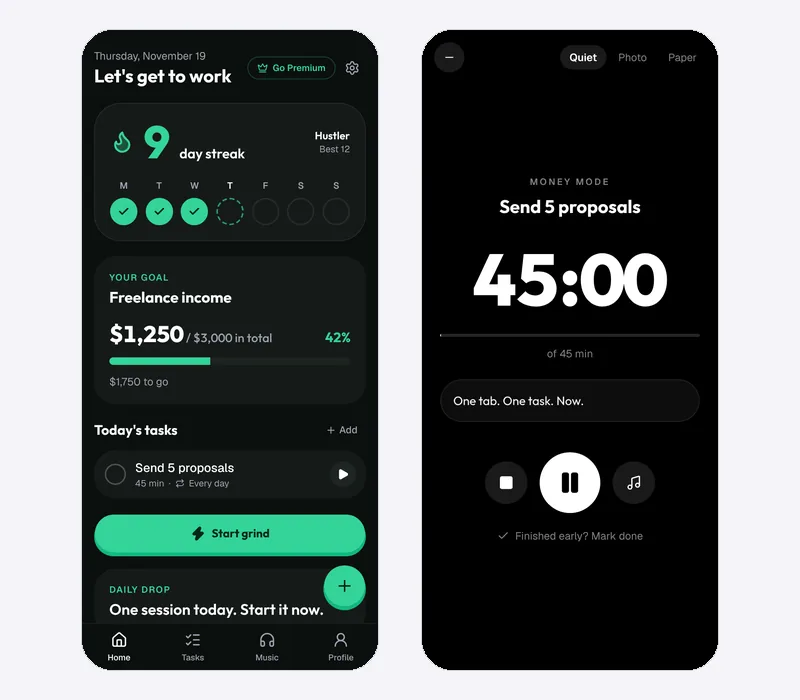
Each task has its own timer length, so your deep work task can run 50 minutes while a quick admin task runs 15. Press play and a full-screen timer starts, with nothing else on screen. Every focus session is logged, and a grind day counts when you finish one task or focus for 25 minutes.
You can set your first money goal free and add tonight's deep work block as your first task. The free plan holds 3 open tasks at once. If you want unlimited tasks and your full history of focus days, Premium covers it, with a 14-day free trial.
FAQ
What is an example of deep work?
Writing a proposal for a big client with your phone in another room and only the proposal open on screen, for 60 minutes straight. Editing a video or coding a feature the same way also counts.
Is deep work the same as flow?
Not quite. Deep work is the practice: hard work, no distractions, set time. Flow is a state of total absorption that often happens during deep work, but you can do deep work on days it never arrives.
Can you do deep work with a full-time job?
Yes. Aim for one focused block of 45 to 90 minutes on work nights and a longer one at the weekend. Consistency matters more than length.
What are Cal Newport's four rules of deep work?
Work deeply, embrace boredom, quit social media, and drain the shallows. In short: schedule focus, train your attention, be choosy with online tools, and shrink low-value tasks.
The short version
Deep work is hard, focused work with no distractions. It's getting rare because we switch screens every 47 seconds on average, which is exactly why it pays. Schedule it, protect it from your phone, shrink shallow tasks, and aim for one solid block a day.

Luiz King
Builds Money Mode, a habit tracker and focus timer made for the money grind.