
Time Management for CEOs: Lessons From 27 CEOs

By Luiz King · · 7 min read
Good time management for a CEO comes down to one rule: decide where your hours go before other people decide for you. In a Harvard study of 27 CEOs, they worked 62.5 hours a week, spent 72% of it in meetings, and only 43% on their own agenda. The fix isn't working more. It's blocking time for the few things only you can do, batching everything else, and checking each week whether your calendar matches your goals.
This guide covers what the research actually found, the four traps it reveals, and a weekly template you can copy, whether you run a 500-person company or a one-person business.
How do CEOs actually spend their time?
The best data comes from Michael Porter and Nitin Nohria of Harvard Business School. They tracked 27 CEOs around the clock for 13 weeks and published the results in Harvard Business Review in 2018. Here's what they found, as reported by Fortune and in an HBR reprint on MGMA:
| What they measured | Average |
|---|---|
| Hours worked per week | 62.5 |
| Hours on a normal weekday | 9.7 |
| Hours on a weekend day | 3.9 |
| Hours on a vacation day | 2.4 |
| Meetings per week | 37 |
| Share of work time in meetings | 72% |
| Share of work time face to face | 61% |
| Sleep per night | 6.9 hours |
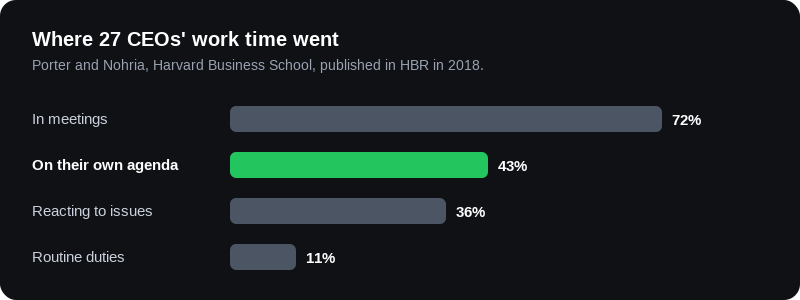
The headline isn't the 62.5 hours. It's that only 43% of their time went to the agenda they set. The rest was reacting (36%) and routine duties like board meetings and earnings calls (11%).
The four time traps the data reveals
1. The calendar fills itself
72% of time in meetings means the calendar runs the CEO, not the other way around. Every meeting someone else books is a decision about your time that you didn't make.
2. Reactive work wins by default
36% reactive isn't a character flaw. Urgent things are loud and important things are quiet. If you don't put your priorities on the calendar first, the urgent stuff takes their place.
3. Interruptions break your thinking
This isn't just a CEO problem. Microsoft's 2025 Work Trend Index found that people using Microsoft 365 are interrupted every 2 minutes during core work hours by a meeting, email or chat. And researcher Gloria Mark says it takes about 25 and a half minutes to get back to an interrupted project.
4. Work leaks into everything
3.9 hours on weekend days and 2.4 hours on vacation days. If you never fully stop, you never fully recover, and your best thinking suffers.
Time management principles that actually work
Most CEO advice boils down to five habits. Here they are, with the trap each one fixes:
| Principle | What it looks like | Fixes |
|---|---|---|
| Block first | Put your top-priority work on the calendar before the week starts | Calendar fills itself |
| Batch the reactive | Answer email and Slack in 2 set windows a day | Reactive work |
| Protect long blocks | At least one 90-minute block with no meetings, most days | Interruptions |
| Default to no | New meetings need an agenda and a reason you're needed | Calendar fills itself |
| Hard stops | A fixed end time and at least one full day off a week | Work leaks |
A CEO weekly template you can copy
This template follows Paul Graham's idea of the maker's and manager's schedules: keep thinking time in the morning and meetings in the afternoon, so one never breaks the other. Adjust the hours to your time zone and energy:
| Time | Mon | Tue | Wed | Thu | Fri |
|---|---|---|---|---|---|
| 8:00–9:30 | Deep work | Deep work | Deep work | Deep work | Weekly review |
| 9:30–10:00 | Inbox window | Inbox window | Inbox window | Inbox window | Inbox window |
| 10:00–12:00 | Team 1:1s | Deep work | Sales / clients | Deep work | Planning next week |
| 13:00–16:00 | Meetings | Meetings | Meetings | Meetings | Open / catch-up |
| 16:00–16:30 | Inbox window | Inbox window | Inbox window | Inbox window | Hard stop |
That's 6 deep work blocks a week (10 hours) on the things only you can do, and meetings packed into afternoons.
What goes in a deep work block?
Only work that needs you and moves the business: strategy, a key hire, a big sales pitch, product decisions, writing. Not email. If you can't name the task before the block starts, it'll turn into email. For more on protecting these blocks when things keep catching fire, read deep work for founders.
Time management for solo founders and small-business owners
If you're a one-person business, you're the CEO and the whole team. The traps are the same, just smaller: client emails instead of board meetings, DMs instead of Slack.
Two changes matter most for you:
- Name one money goal. A CEO's agenda is set by strategy. A solo founder's should be set by a number, like "$25k a month by June". Every deep work block should move that number.
- Put your revenue-driving tasks first. Outreach, sales calls and building the product go in the morning block. Admin goes in the afternoon.
Use Money Mode to protect your priorities
Money Mode is an app for people making money online. You set one money goal, add the daily tasks that move it, and start a focus timer with one tap. It runs in your browser and installs on your phone like an app.
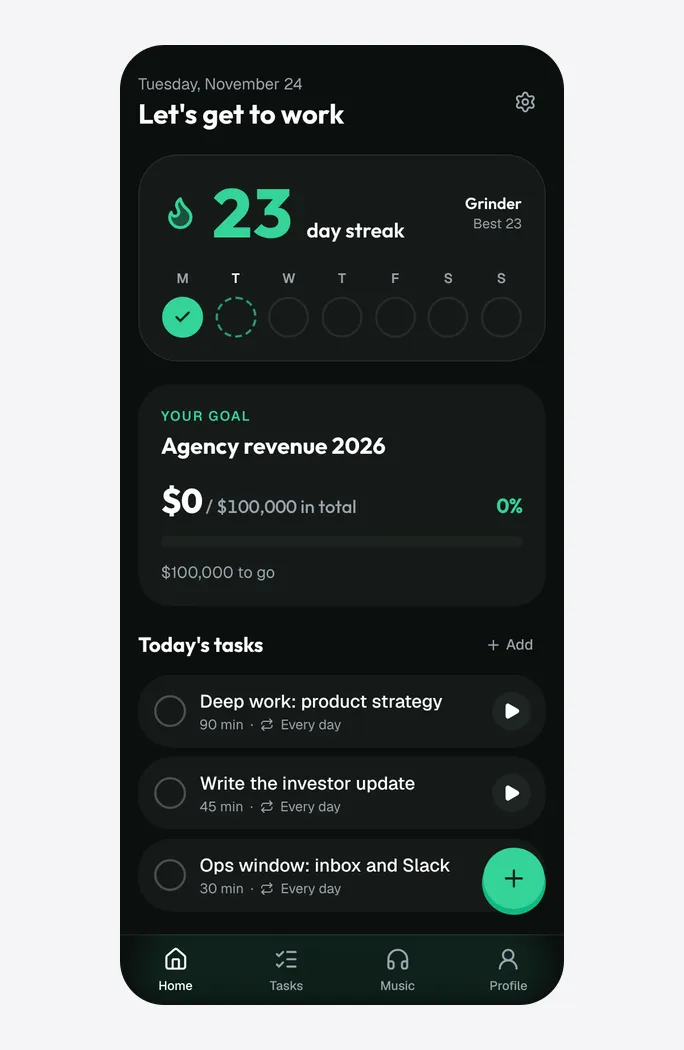
Here's how the template maps onto it:
- Your deep work block becomes a recurring task like "Deep work: product strategy, 90 min". Tap play and the timer runs full screen.
- Your inbox windows become a task too, with a 30-minute timer, so email has an end.
- Finishing one task, or 25 focus minutes, counts as a grind day. A visible streak makes it harder to let meetings eat the block.
It's free to start, and the free plan holds 3 open tasks at once. That's enough for a deep work block, an inbox window and one sales task. Set your first money goal free.
FAQ
How many hours a week do CEOs work?
In Porter and Nohria's study, the 27 CEOs averaged 62.5 hours a week, including 3.9 hours on weekend days and 2.4 hours on vacation days.
What is the most important time management skill for a CEO?
Deciding your priorities before the week starts and blocking time for them. In the study, CEOs spent only 43% of their time on their own agenda; the rest was reactive or routine.
How much time should a CEO spend in meetings?
There's no fixed number, but 72% (the study's average) leaves little room for thinking. A practical target is to protect at least one 90-minute meeting-free block most days.
What's the best time management method for founders?
Time blocking with batched communication: block deep work in the morning, answer messages in two set windows, and hold meetings in the afternoon. Our guide to how long a deep work session should be helps you size the blocks.
The short version
The CEOs in the Harvard study had full calendars and less than half their time on their own agenda. Don't copy the hours. Copy the fix: block your priorities first, batch the reactive work, protect long blocks and set a hard stop. Then check every Friday whether your calendar matched your goal.

Luiz King
Builds Money Mode, a habit tracker and focus timer made for the money grind.