
Maker's Schedule vs Manager's Schedule: A Founder's Guide

By Luiz King · · 7 min read

A manager's schedule cuts the day into one-hour slots for meetings. A maker's schedule keeps time in blocks of at least half a day, because building, writing or coding needs long, unbroken stretches. Founders need both, so the fix isn't choosing one. It's separating them: maker time in big blocks (usually mornings), manager time batched together (usually afternoons or set days), and never one meeting dropped in the middle of a build block.
This post explains Paul Graham's original idea in plain words, shows why one meeting costs more than an hour, and gives you three weekly templates to copy, depending on how much of your job is making versus managing.
What is the maker's schedule vs the manager's schedule?
The idea comes from Paul Graham's July 2009 essay, Maker's Schedule, Manager's Schedule. Graham co-founded Y Combinator, the startup accelerator.
He described the manager's schedule like this: "It's embodied in the traditional appointment book, with each day cut into one hour intervals." Managers can drop a meeting into any slot. It costs them an hour, nothing more.
Makers, like programmers and writers, work differently: "They generally prefer to use time in units of half a day at least. You can't write or program well in units of an hour."
| Manager's schedule | Maker's schedule | |
|---|---|---|
| Unit of time | 1 hour | Half a day or more |
| A meeting costs | One slot | Can wreck the whole block |
| Good for | Decisions, sales, hiring, unblocking people | Building, writing, coding, strategy |
| Founders who live here | CEOs of 30+ person companies | Solo founders, technical founders |
Why one meeting costs more than an hour
Graham's key line: "A single meeting can blow a whole afternoon, by breaking it into two pieces each too small to do anything hard in."
Here's what that looks like with a single 30-minute meeting:
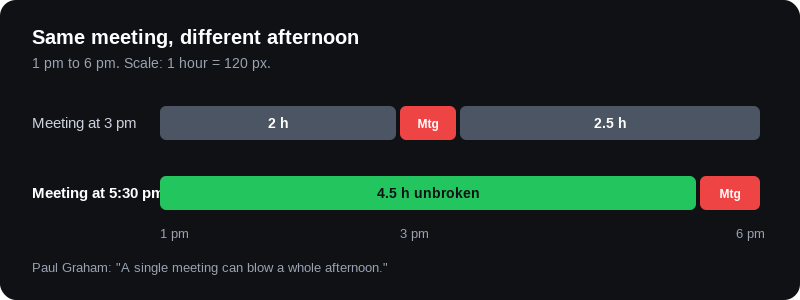
There's research behind the feeling too. Gloria Mark, who studies attention at UC Irvine, says it takes about 25 and a half minutes to get back to an interrupted project. And the damage spreads. Graham calls it a "cascading effect": "If I know the afternoon is going to be broken up, I'm slightly less likely to start something ambitious in the morning."
Why founders get stuck between both schedules
Early on, you're a maker: you build the product or deliver the service. As you grow, you become a manager: sales calls, hiring, team 1:1s, investors. Most founders end up with both jobs and no plan for how they fit.
The result is a calendar with meetings sprinkled everywhere and no block longer than 90 minutes. Everything gets done halfway.
Graham's own fix was simple. He kept a maker's schedule and held office hours: "Several times a week I set aside a chunk of time to meet founders we've funded. These chunks of time are at the end of my working day." Because they came at the end, "these meetings are never an interruption."
Three weekly templates to copy
Pick the one closest to how much of your job is making.
1. Mostly maker (solo founder, technical founder, creator)
| Mon | Tue | Wed | Thu | Fri | |
|---|---|---|---|---|---|
| Morning | Build | Build | Build | Build | Build |
| Afternoon | Build | Calls (3–5 pm) | Build | Calls (3–5 pm) | Admin + review |
Meetings live in two afternoon windows. Everything else is maker time.
2. Half and half (agency owner, small team lead)
| Mon | Tue | Wed | Thu | Fri | |
|---|---|---|---|---|---|
| Morning | Deep work | Deep work | Deep work | Deep work | Deep work |
| Afternoon | Team + clients | Sales calls | Team + clients | Sales calls | Planning |
Mornings are protected for making. Afternoons are manager time.
3. Mostly manager (CEO with a team)
| Mon | Tue | Wed | Thu | Fri | |
|---|---|---|---|---|---|
| Morning | 90-min think block, then meetings | Meetings | Maker day | Meetings | 90-min think block, then review |
| Afternoon | Meetings | Meetings | Maker day | Meetings | 1:1s |
One full maker day a week, plus two short think blocks. Even a busy CEO can hold that. For the bigger picture, see our guide to time management for CEOs.
How to make the split stick
A template only works if other people respect it. Four rules that help:
- Make it visible. Block maker time in your shared calendar as "Busy: focus". People book around what they can see.
- Give people a meeting window. "I take calls Tuesday and Thursday 3–5 pm" is easier to respect than "I'm busy in the mornings."
- Move meetings to the edges. Start or end of the day, or next to other meetings, never in the middle of a block.
- Keep a real emergency lane. A phone call for real fires, everything else waits. Our post on deep work for founders has a 10-second test for what counts.
Run your maker blocks with Money Mode
Money Mode is an app for people making money online. You set one money goal, add the daily tasks that move it, and start a focus timer with one tap. It runs in your browser and installs on your phone like an app.
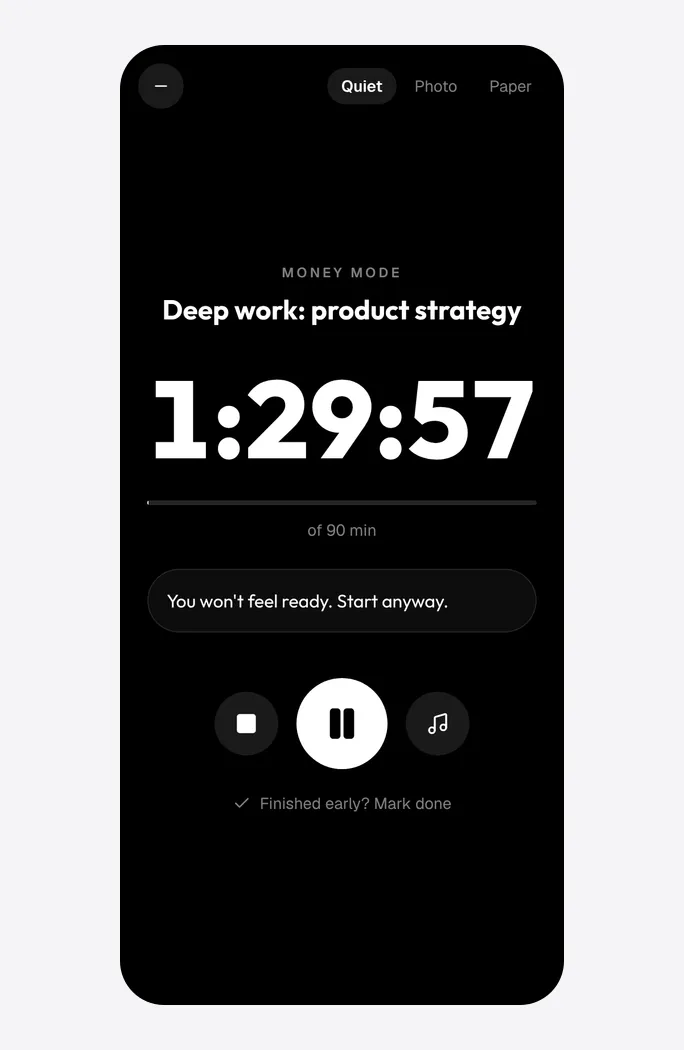
To turn your maker blocks into a habit:
- Add your block as a daily task, like "Build: checkout flow, 90 min". Tap play to start the timer.
- Name the task, not just the time. "Deep work" alone turns into email. "Write the pricing page" doesn't.
- Let the streak guard the block. One finished task, or 25 focus minutes, counts as a grind day, so a broken afternoon doesn't break your streak if you protected the morning.
It's free to start. Set your first money goal free and turn tomorrow morning into a maker block.
FAQ
What did Paul Graham mean by maker's schedule?
That people who create things (code, writing, design) need time in units of at least half a day, because hard work needs long, unbroken stretches. Meetings in the middle of those stretches cost far more than their length.
Can you have a maker's schedule as a CEO?
Partly. Most CEOs can protect one maker day a week or a 90-minute block on a few mornings. The key is putting meetings together instead of spreading them across every day.
Is it better to do maker time in the morning?
For most people, yes, because messages and meetings pile up as the day goes on. Graham himself put his meetings at the end of the day. Pick the time you can protect most reliably.
How long should a maker block be?
Graham says half a day at least. If that's not realistic yet, start with 90 minutes. Our guide to how long a deep work session should be helps you build up.
The short version
Managers think in hours; makers think in half-days. Founders are both, so split them: maker blocks in the morning, meetings batched in set windows, and never one meeting in the middle of a build block. Where a meeting goes matters more than how long it is.

Luiz King
Builds Money Mode, a habit tracker and focus timer made for the money grind.