
How to Be Self-Disciplined When You Work for Yourself

By Luiz King · · 7 min read

Self-discipline when you work for yourself comes from structure, not willpower. A boss used to set your hours, pick your priorities, give you deadlines, check your work and keep distractions down. When you work alone, nobody does those five jobs, so they quietly stop happening. Rebuild each one with a small rule and most of the "discipline problem" goes away.
Below is what each of those five jobs looks like when you do it yourself, a copyable weekly review, and what to do on the days it all falls apart.
Why is self-discipline so hard when you're your own boss?
Because you lost a system, not a personality trait. At a job, a lot of discipline is borrowed. You show up at 9 because others expect you. You finish the report because someone will ask for it on Thursday. You don't scroll for an hour because a coworker can see your screen.
When you work for yourself, all of that disappears at once. So "I have no discipline" usually means "I have no structure". Structure is easier to fix.
Willpower isn't the answer (and may not run out the way you think)
You've probably heard that willpower is like a battery: use it in the morning and it's empty by night. That idea, called "ego depletion", was popular for years. Then 23 labs ran the same test with 2,141 people and found an effect "small with 95% confidence intervals (CIs) that encompassed zero" (Hagger et al., 2016). In plain words: for the task they tested, they couldn't find it.
Researchers still debate the details. But there's a better-supported idea: people who seem disciplined lean on habits, not on resisting temptation all day. Across six studies with 2,274 people, Galla and Duckworth found that good habits help explain why people with high self-control do better (Galla & Duckworth, 2015). We go deeper on that research in motivation vs discipline.
The 5 jobs your boss did, and how to do them yourself
Here's the whole system on one page. Each row replaces one thing a boss or office used to do for you.
| What a boss did | Your replacement | Time it takes |
|---|---|---|
| Set your hours | A fixed start time and a fixed stop time | 0 minutes, just a rule |
| Picked your priorities | One "money task" per day, from a weekly top 3 | 10 minutes on Sunday |
| Gave you deadlines | A dated deadline someone else knows about | 2 minutes per project |
| Checked your work | A 20-minute weekly review with numbers | 20 minutes on Friday |
| Kept distractions down | Phone in another room, one tab per task | 0 minutes, just a rule |
1. Set your hours: a start time and a stop time
Pick a start time and treat it like a meeting with a client. "I start at 7:30 pm" or "I start at 9:00 am". Same time, every workday.
Then pick a stop time too. Without a stop, work spreads across the whole evening, you feel like you never stop, and you start avoiding it. A clear end makes the start easier.
2. Pick your priorities: one money task a day
On Sunday, write your top 3 for the week: the three results that would move your income most, like "send 25 proposals" or "launch the new offer page". Then each day, pick one money task from those three and do it first.
A money task is work that leads to getting paid: outreach, client work, a sales page, a product launch. Tidying your files and redesigning your logo don't count, even though they feel like work.
3. Give yourself deadlines someone else knows about
A deadline only in your head is easy to move. So attach a date and a witness:
- Tell a client: "You'll have the draft by Wednesday."
- Tell a friend: "I'm launching the offer page on the 15th. Ask me how it went."
- Post it: "New product drops Friday."
You're not doing this to feel ashamed if you miss it. You're doing it because a date that someone else knows about is harder to quietly push.
4. Check your own work: the Friday review
A boss notices when output drops. You need a way to notice too. Once a week, spend 20 minutes on this:
| Question | Example answer |
|---|---|
| How many days did I do my money task? | 4 of 5 |
| What did I ship or send? | 22 proposals, 1 sales page draft |
| What made money or got a reply? | 2 replies, 1 call booked |
| What got in the way? | Two late nights of scrolling |
| What's my top 3 for next week? | 25 proposals, finish sales page, follow up on the call |
Keep the answers short. The point is to look at the numbers before your mood rewrites them.
5. Keep distractions down: make the easy choice the right one
At an office, other people make scrolling awkward. At home, nothing does. So change the room instead of fighting yourself:
- Phone in another room while you do your money task.
- One tab, one task. Close everything that isn't the task.
- Same place every time, even if it's just one end of the kitchen table.
If your phone is the main problem, here's how to stop checking your phone while working.
What to do on the days it all falls apart
Some days the system breaks: you oversleep, a family thing comes up, or you just don't want to. Don't throw the whole week away. Use a minimum day:
- Do 20 minutes on your money task, or just its first step.
- Write one line in your notes about what got in the way.
- Go back to the full plan tomorrow.
One bad day doesn't break a habit. In a well-known University College London study, "a single missed day had little impact" on how automatic a habit became (British Psychological Society summary). Treating a bad day as proof that you "have no discipline" is what does. If you missed a run of days, see what to do after you break a streak.
How Money Mode acts as your boss
Money Mode is a free-to-start app for people making money online. You set a money goal, do one small task a day to keep your streak, and start a focus timer with one tap. It runs in your browser and installs on your phone like an app.
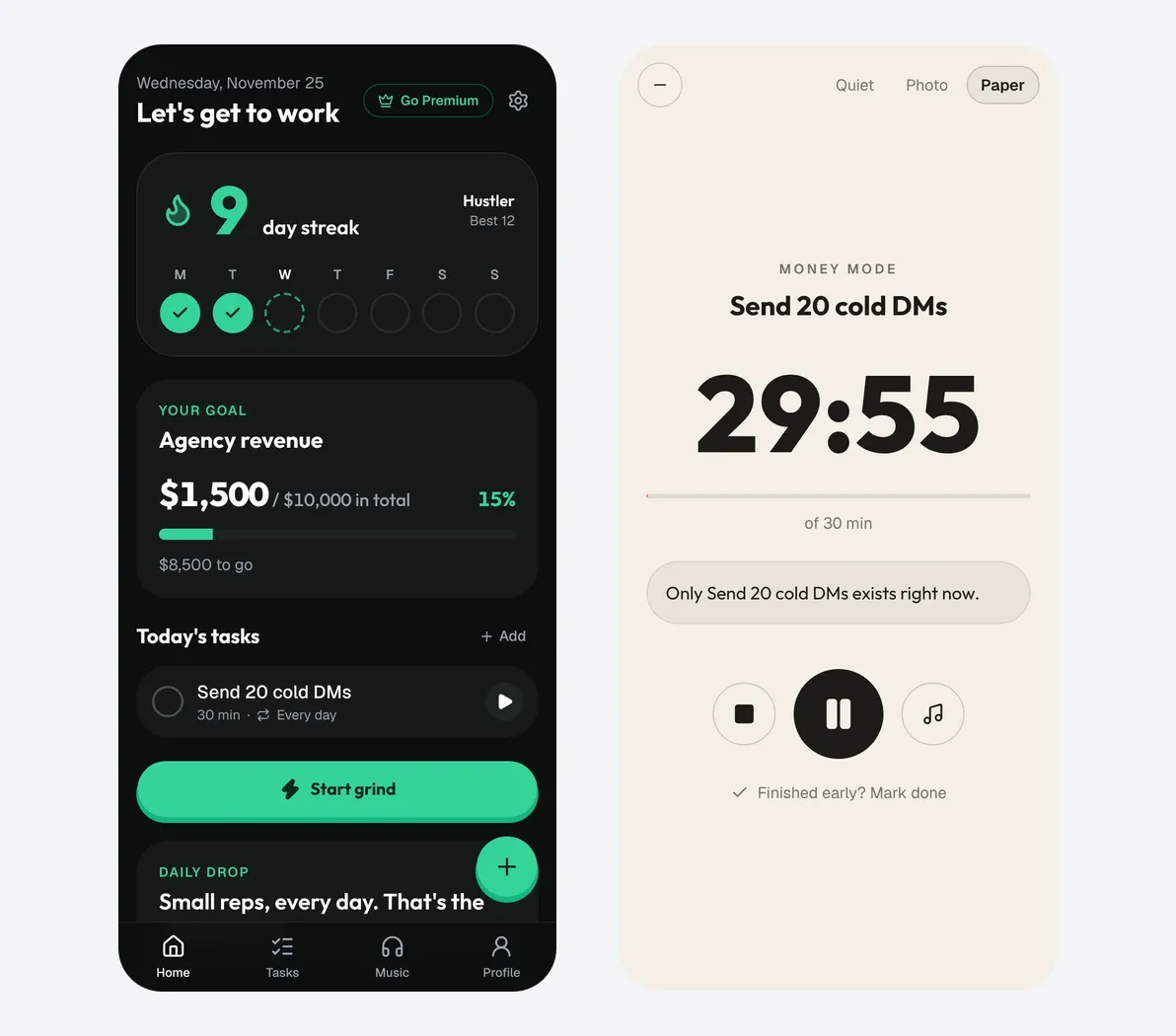
It covers several of the five jobs at once:
- Priorities: your money goal and today's tasks are the first thing you see.
- Hours and focus: tap play on a task and a full-screen timer starts, with nothing else on screen.
- Checking your work: a day counts as a grind day when you finish one task or focus for 25 minutes, and your streak shows how many days in a row you've shown up.
- Bad days: the free plan gives you one streak freeze a week, so one missed day doesn't erase your streak.
You can set your first money goal free and add your first money task in about a minute. Premium adds unlimited tasks, more freezes and cloud sync, with a 14-day free trial (pricing).
FAQ
How do I stay disciplined when working from home?
Give your day a fixed start and stop time, do one money task first, and keep your phone in another room. Structure does most of the work willpower can't.
Is self-discipline a skill you can learn?
Mostly, yes, in the sense that you can build habits and set up your space. Research suggests disciplined people rely on good habits more than on resisting temptation.
Why can't I focus when I work for myself?
Usually because the structure a job gave you is gone: no fixed hours, no deadlines, no one checking in. Rebuild those, starting with a start time and one daily money task.
What should I do when I don't feel like working?
Do a minimum day: 20 minutes on your money task, or just the first step. Starting is the hard part, and a small start keeps the habit going.
The short version
When you work for yourself, discipline is a set of small rules that replace your old boss: a start and stop time, one money task a day, deadlines someone else knows about, a Friday review and a distraction-free spot. Build those five, keep a minimum day for bad days, and stop judging yourself by your willpower. For a full routine to copy, see how to stay motivated working alone.

Luiz King
Builds Money Mode, a habit tracker and focus timer made for the money grind.