
How to Stay Motivated Working Alone (A Setup That Lasts)

By Luiz King · · 7 min read

To stay motivated working alone, stop waiting to feel motivated and replace what an office gives you for free: a fixed start time, people around you, a boss who checks in, and a clear sign of progress. Build each of those on purpose, and motivation shows up after you start, not before.
Here's why working alone drains motivation, the five things to rebuild, and a weekly setup you can copy.
Why is it so hard to stay motivated when you work alone?
Because an office does a lot of motivating that you never notice. Someone sees you arrive. A coworker asks how the project is going. There's a meeting at 10, so you prepare at 9. Take all of that away and every hour depends on you deciding, again, to work.
It's also lonely. In Buffer's 2023 survey of 3,000 remote workers, 23% picked loneliness as one of their struggles, and 15% picked it as their single biggest one. Only "I stay home too often" was picked more (Buffer, 2023).
If you run a side hustle, a solo agency or a store from your bedroom, that's your daily setup. So the fix isn't a better pep talk. It's a better setup.
1. Give your day a fixed start
Offices start at a set time. Solo days start "whenever", which often means "after one more video".
Pick a start time and a start action, and keep both the same every day: "At 8:30 I sit at my desk and open today's task." Use the same spot if you can. A fixed start removes the daily debate about whether to begin.
If you work from home, a short "fake commute" helps too: a 10-minute walk before you sit down and another when you stop. It marks the edges of the workday, which home doesn't do on its own. (Your evenings matter as much as your mornings. Here's how to plan around tired nights.)
2. Make progress visible every day
At a job, progress is visible: a finished ticket, a pat on the back, a paycheck. Solo work often has none of that for weeks. You send 40 DMs and get one reply. It feels like nothing is happening.
So make the input visible, not just the result:
- A streak of days you did your money task.
- A count of outreach sent, videos posted or listings added this week.
- A goal bar that moves when money comes in.
Seeing "day 14" is a small reason to do day 15. That's the whole point. (For the bigger picture on why systems beat moods, read motivation vs discipline.)
3. Borrow other people's presence (body doubling)
Body doubling means working while someone else is there, even if they're doing something else. It can be a friend at the same table or a stranger on a video call.
Focusmate is one service built on this idea. It pairs you with another person on camera for a 25, 50 or 75-minute session, and each of you works on your own task. It's free for up to three sessions a week (Focusmate).
You don't need an app for it. These work too:
- A café or library for your hardest task of the week.
- A standing call with a friend who also works alone: cameras on, mics off, one hour.
- A coworking day pass once a week.
4. Get a check-in (accountability)
A boss is annoying, but they do one useful thing: they ask what you got done. Working alone, nobody asks. Rebuild that on purpose.
- A weekly check-in. Every Friday, send one friend three lines: what you did, what you didn't, what's next.
- A public log. Post your weekly numbers on X or in a community for your hustle.
- A written plan. Write tomorrow's one task before you stop today. You check in with tomorrow's you.
Make the check-in about your actions (DMs sent, hours worked), not your income. You control actions. You don't control when a client says yes.
5. Plan real human contact
Buffer's survey shows loneliness is a real cost of remote work, and it doesn't fix itself. Put people on your calendar like you'd put a client call there:
- One lunch or coffee with a friend per week.
- One community event, meetup or online group call per month.
- A walk outside during the day, not just after dark.
This isn't a productivity hack. It's what keeps working alone sustainable for years instead of months.
A weekly setup you can copy
Here's one example week for someone working alone on their hustle. Change the times to fit you.
| When | What | Why |
|---|---|---|
| Every workday, 8:30 | Same desk, open today's one task, start a timer | Fixed start |
| Every workday | Check off the task, watch the streak grow | Visible progress |
| Tue and Thu, 10:00 | 50-minute body doubling session (friend or Focusmate) | Presence |
| Wednesday | Work your hardest task from a café or library | Change of scene |
| Friday, 17:00 | Send your 3-line weekly check-in | Accountability |
| Saturday | Lunch with a friend, no work talk | Human contact |
How Money Mode helps when you work alone
Money Mode is a free-to-start app for people making money online. You set a money goal, do one small task a day to keep your streak, and start a focus timer with one tap. It runs in your browser and installs on your phone like an app.
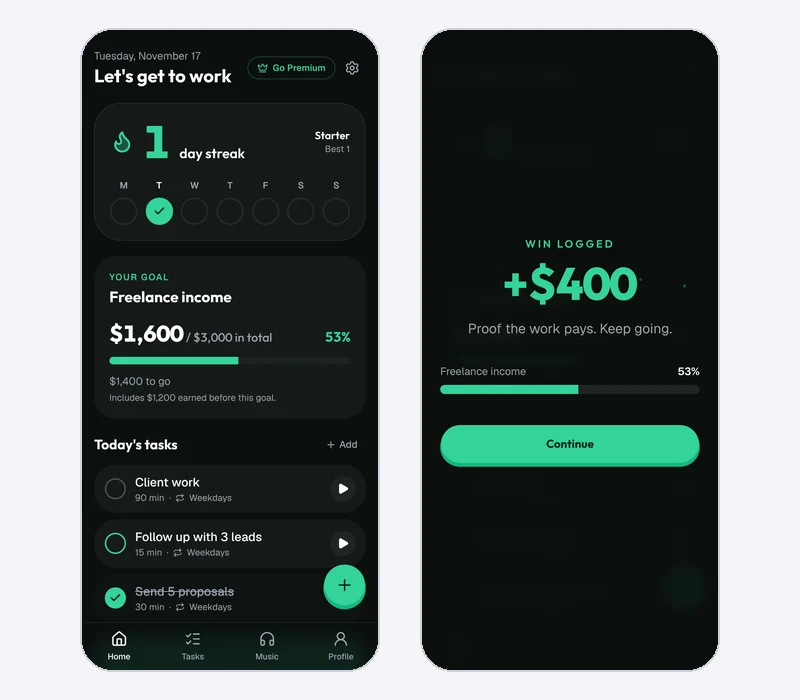
It covers two of the five pieces: the fixed start and the visible progress. Your daily task waits on the home screen with a play button, so starting is one tap. Your streak and goal bar show that the work is adding up, even in the weeks before money comes in. A grind day counts when you finish one task or focus for 25 minutes.
You can set your first money goal free and set tomorrow's start task now. The free plan holds 3 open tasks at once. When your solo week has more moving parts, Premium gives you unlimited tasks and your full history of grind days, with a 14-day free trial.
FAQ
How do I motivate myself when working from home alone?
Don't rely on feeling motivated. Set a fixed start time and place, make your daily progress visible, and add people back into your week through body doubling, check-ins and real social plans.
Is it normal to feel lonely working alone?
Yes. In Buffer's 2023 survey of remote workers, 23% named loneliness as a struggle. Plan social contact on purpose, and talk to someone if the feeling lasts for weeks.
What is body doubling?
Working alongside another person, in person or on video, while each of you does your own task. Having someone there makes it easier to start and keep going. Services like Focusmate set up these sessions for you.
How do I stay accountable when I'm self-employed?
Pick one person or group and report your actions to them every week: what you did, what you skipped and what's next. Keep it about actions you control, not results.
The short version
Working alone takes away a fixed start, people, check-ins and visible progress. Rebuild each one on purpose. Start at the same time every day, track your streak, work next to someone a few times a week, send a weekly check-in, and put friends on your calendar.

Luiz King
Builds Money Mode, a habit tracker and focus timer made for the money grind.