
How to Build a SaaS While Working Full Time

By Luiz King · · 6 min read

You can build a SaaS (software as a service: an app people pay for monthly) while working full time. But you have to plan for the hours you actually have, not the ones you wish you had. Check your employment contract first, cut the product to one small feature, work in short blocks on most days, and talk to users every week. Measure progress in MRR, not in lines of code.
Here's the full plan, plus a weekly schedule.
Step 0: Read your employment contract
Do this before you write a line of code. Many employment contracts include an invention assignment clause, which says your employer owns things you create. Some also limit outside work.
The rules depend on where you live. In California, for example, Labor Code section 2870 says an employer generally can't claim an invention you build entirely on your own time, without the company's equipment, supplies, facilities or trade secrets. But there are exceptions: inventions that relate to the employer's business or research, or that come from work you did for them (California Labor Code § 2870).
What that means in practice:
- Never build it on your work laptop, on work time or with work accounts.
- Be extra careful if your SaaS is close to what your employer sells.
- If your contract is unclear, ask a lawyer. A short consultation costs far less than losing your product.
Step 1: Shrink the product to one job
With 6 to 8 hours a week, a "platform" will take years. One feature that solves one painful problem can ship in weeks.
Write one sentence: "[Who] uses this to [do one thing] so they can [result]." If you can't fit your product in that sentence, cut until you can. Everything else goes on a "later" list.
Step 2: Work in small daily blocks, not weekend marathons
When you have a day job, energy is the real limit, not time. Cal Newport notes that few people can keep peak focus for more than an hour or so without a break (Cal Newport). After 8 hours at work, you have even less.
So plan for one focused block on most weeknights, and one longer block at the weekend:
| Day | Block | Focus |
|---|---|---|
| Mon–Thu | 60 min | Build: one small, finished change |
| Fri | Off | Rest |
| Sat | 2–3 hours | The hard part: a bigger feature or a tricky bug |
| Sun | 45 min | Users and marketing: reply to users, write one post, plan the week |
That's about 7 to 8 hours a week. For how to pick a number that fits your life, see how many hours a day to work on a side hustle.
End every block with a note for tomorrow
The hardest part of a short block is starting it. Before you close the laptop, write one line: "Next: fix the signup email." Tomorrow you open the note and start, instead of spending 20 minutes remembering where you were.
Keep a floor for tired nights
Some nights you won't have an hour. Have a floor: a 20-minute task like fixing one small bug or answering one user. A small step keeps the project moving. A week of skipped nights is how side projects die. (Here's a minimum-day plan for tired nights.)
Step 3: Talk to users every week
Building alone feels productive. Talking to users feels slow. But code nobody needs is the most expensive kind.
Put one user task in every week: reply to feedback, do a short call, or post where your users hang out. Money Mode's SaaS template suggests three daily tasks: "1 hour building the product", "talk to 1 user" and "1 marketing post". Users sit right next to building, because a product nobody uses stays a hobby.
Step 4: Track MRR, not features shipped
MRR means monthly recurring revenue: what your subscribers pay you each month. It's the number that tells you whether your SaaS is working. Feature count doesn't.
If you charge monthly, set your goal in MRR. If you also take one-time payments, here's MRR vs total revenue goals and which to track.
When can you quit your job?
Set the number before you get emotional about it. A simple rule: work out your monthly costs, add a buffer for taxes and slow months, and keep your job until MRR covers that number for several months in a row.
You can put your target into the free money goal calculator to see how many sales and weeks it could take at your current pace. It shows the math, not a promise.
How Money Mode helps you ship on weeknights
Money Mode is a free-to-start app for people making money online. You set a money goal, do one small task a day to keep your streak, and start a focus timer with one tap. It runs in your browser and installs on your phone like an app.
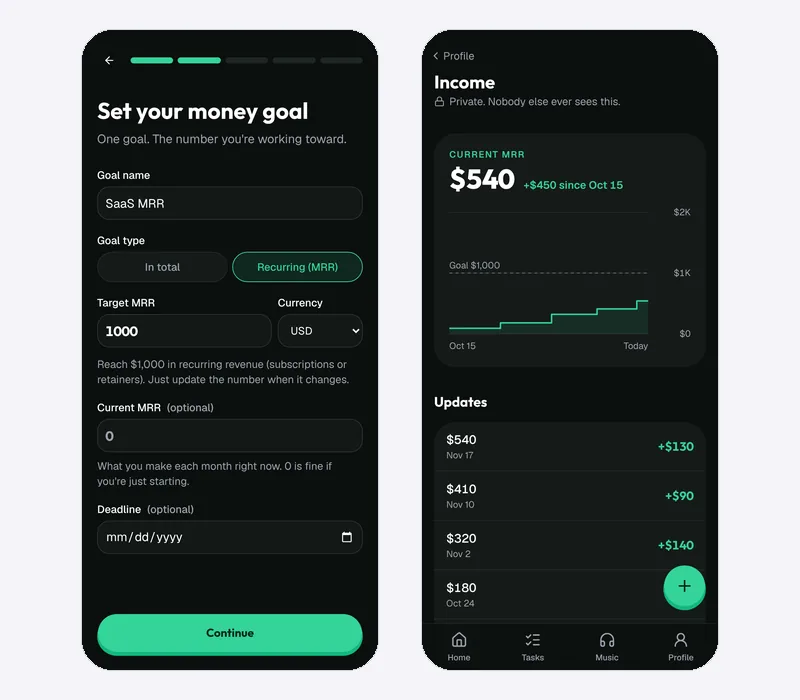
For SaaS, it suggests a $1,000 MRR goal. You update one number when your MRR changes and watch the step chart climb. A grind day counts when you finish one task or focus for 25 minutes, so a tired-night floor still keeps your streak alive.
Set your first money goal free and add your first build block as a task. The free plan allows 3 open tasks at once. Premium removes that limit, syncs your data across devices and keeps your full history, so you can look back at months of MRR. It comes with a 14-day free trial.
FAQ
How many hours a week do you need to build a SaaS on the side?
There's no fixed number, but 6 to 10 focused hours a week is realistic for most people with a full-time job. Doing it every week matters more than the total. Small scope plus steady weeks ships faster than big scope plus burnout.
Can my employer own my side project?
Sometimes. Many contracts include invention assignment clauses. Some places limit them. California, for example, protects inventions made entirely on your own time and equipment, with exceptions. Read your contract and ask a lawyer if you're unsure.
Should I build at night or in the morning?
Pick the slot you can protect most often. Mornings suit people who can go to bed early and think clearly before work. Evenings suit people who rest first after work. Consistency beats the "perfect" time.
When should I quit my job for my SaaS?
When your MRR has covered your monthly costs plus a buffer for several months in a row, not after one good month. Decide the number in advance so you aren't deciding on hype.
The short version
Check your contract. Cut the product to one job. Build in short blocks on most days, with a long block at the weekend and a note for tomorrow at the end of each session. Talk to users weekly, track MRR, and set your quit number before you need it.

Luiz King
Builds Money Mode, a habit tracker and focus timer made for the money grind.