
How Long Does It Take to Build a Habit? (Not 21 Days)

By Luiz King · · 7 min read
It takes about two months for a new habit to feel automatic, on average. The best-known study put the average at 66 days. But the range is huge, from under three weeks to most of a year, and harder habits sit at the slow end. The popular "21 days" number isn't backed by research.
This post covers where the 21-day myth came from, what the studies actually found, what speeds a habit up, and a 66-day plan you can use for a side hustle.
The short answer
A new daily habit takes around 2 months to feel automatic, and often longer. A 2024 review of 20 studies with 2,601 people found median times of 59 to 66 days and average times of 106 to 154 days, with individual results from 4 to 335 days (Singh et al., 2024).
Why do the median and average differ so much? A few people took a very long time, which pulls the average up. The median is closer to what a typical person can expect.
Where did "21 days" come from?
From a plastic surgeon, not a habit study. In the 1950s, Maxwell Maltz noticed his patients took about three weeks to get used to a change. In his 1960 book Psycho-Cybernetics he wrote that "it requires a minimum of about 21 days for an old mental image to dissolve and a new one to jell" (James Clear's history of the 21-day myth).
Notice the word minimum. Over time, people dropped it, and "at least about 21 days" became "21 days". The 2024 review says its results refute the idea that habits can generally be formed in about 21 days (Singh et al., 2024).
What the main study found: 66 days on average
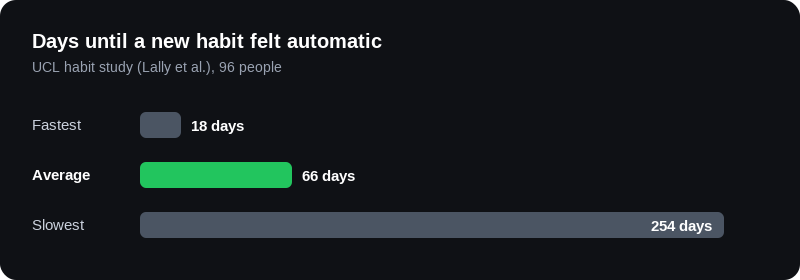
The study most people quote is from University College London. Researchers asked 96 people to pick a new daily habit, like drinking water with lunch or going for a run. 82 stuck with the study to the end (BPS Research Digest summary of Lally et al.).
- On average, it took 66 days for the habit to reach its peak "automaticity" (doing it without having to think).
- The range ran from 18 days to a predicted 254 days.
- Harder habits took longer. People who picked an exercise habit took about one and a half times as long as people who picked an eating or drinking habit.
A side hustle task, like sending proposals or editing a video, is closer to exercise than to drinking a glass of water. It takes effort and willpower to start. So expect the slower half of the range.
Does missing a day break a habit?
No. One missed day barely matters. In the UCL study, a single missed day had little impact on how automatic the habit became later. But many missed days did add up (BPS Research Digest).
That's the real rule: never miss twice in a row. One missed day is a blip. A missed week is a new habit: the habit of not doing it. (Here's what to do after you break a habit streak, step by step.)
What makes a habit form faster?
The 2024 review looked at what was linked to stronger habits. Frequency, timing, the type of habit, personal choice and how much people enjoyed the habit all mattered. Morning habits and habits people chose themselves tended to be stronger (Singh et al., 2024).
Here's how that turns into rules for a side hustle:
| What helps | What it means for you |
|---|---|
| Do it often | Daily beats "3 times a week". Shrink the task until daily is possible. |
| Same time each day | Tie it to a fixed moment, like right after dinner. |
| You chose it | Pick a task you actually believe moves your goal, not one from a guru's list. |
| You enjoy it (a bit) | Make it pleasant: good music, a favorite drink, a visible win. |
| Mornings | If your schedule allows, do the task before the day job, not after. |
Tying the new habit to a fixed moment is called habit stacking, and it has its own guide: habit stacking for your side hustle, with 10 stacks you can copy.
Why 2 months feels so long (and how to get through it)
Most people quit in the gap between "this is exciting" and "this is automatic". The new feeling wears off after a week or two, but the habit isn't running on its own yet. So every day still costs effort.
Three things help you cross that gap:
- A tiny daily minimum. On a bad day, the habit is 5 to 10 minutes, not an hour. Small days keep the chain alive. (More on this in how to stay consistent with a side hustle.)
- A visible count. Seeing "day 23" is a reason to do day 24. That's what a streak is for.
- A plan for misses. Decide now what happens when you miss a day, so one bad night doesn't end it.
A 66-day side hustle habit plan
Use this as a template. The phases are examples, not research milestones.
| Days | Focus | Daily minimum (example) |
|---|---|---|
| 1–7 | Just show up | 10 minutes on one task, same time every day |
| 8–21 | Protect the chain | 20 minutes; never miss twice in a row |
| 22–45 | Build volume | 25–45 minutes, one clear output (5 proposals, 1 clip) |
| 46–66 | Make it yours | Keep the time slot; add a second habit only if the first feels easy |
How Money Mode helps you get to day 66
Money Mode is a free-to-start app for people making money online. You set a money goal, do one small task a day to keep your streak, and start a focus timer with one tap. It runs in your browser and installs on your phone like an app.
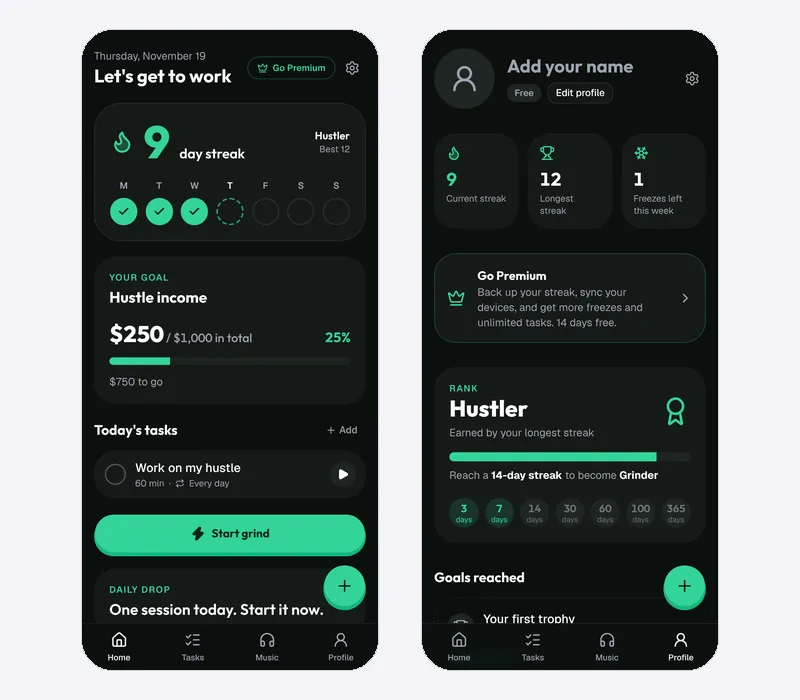
It's built for the two-month gap. A grind day counts when you finish one task or focus for 25 minutes, so your daily minimum is small on purpose. Your streak shows the count. And because one missed day shouldn't erase weeks of work, the free plan gives you one streak freeze per week to cover it.
You can set your first money goal free and start day 1 tonight. Once your streak is long enough that you'd hate to lose it, Premium gives you 3 freezes a week and unlimited tasks for a second habit. You can try it free for 14 days.
FAQ
Is it 21 days or 66 days to form a habit?
Neither is a rule. 21 days comes from a 1960 self-help book, not a study. Research puts the typical time at about 2 months, with a range from a few weeks to most of a year.
How long does it take to break a bad habit?
The studies above measured new habits, not breaking old ones, so there's no solid number. The same ideas help, though: change the cue, make the bad habit harder to start, and replace it with something specific.
Does a habit ever become fully automatic?
It gets close. In the UCL study, automaticity rose fast at first and then levelled off. The habit gets easier, but hard habits like exercise or deep work may always take a little effort to start.
How many days in a row should I do a habit?
As many as you can, but don't treat one miss as failure. One missed day had little effect in the UCL study. Aim for daily, and never miss two days in a row.
The short version
Plan for about two months, not 21 days. One missed day is fine, two in a row is a warning. Keep the daily task small, do it at the same time, pick something you chose yourself and make your progress visible. Day 66 comes faster when you're not starting over every week.

Luiz King
Builds Money Mode, a habit tracker and focus timer made for the money grind.