
Habit Stacking for Your Side Hustle: 10 Stacks to Copy

By Luiz King · · 6 min read

Habit stacking means attaching your side hustle task to something you already do every day: "After I pour my coffee, I'll send 5 proposals." The old habit becomes the reminder for the new one, so you stop relying on memory or mood. It works best when the anchor is fixed and the new task is small.
Below you'll find the formula, why it works, how to pick a good anchor, and 10 side hustle stacks you can copy tonight.
What is habit stacking?
Habit stacking is pairing a new habit with a current one using a simple sentence. James Clear, author of Atomic Habits, writes the formula like this (James Clear):
After/Before [CURRENT HABIT], I will [NEW HABIT].
Clear credits the idea to behavior scientist BJ Fogg, who calls the current habit an "anchor" in his Tiny Habits method (James Clear).
For a side hustle, the new habit is your daily money task. For example: "After I close my work laptop, I will open my side hustle task list and start a 25-minute timer."
Why it works: you've already decided when
Most side hustles don't fail because people don't care. They fail because "I'll do it later tonight" has no clear moment. Later never comes.
Habit stacking fixes that by deciding the when in advance. Clear calls it a special form of an implementation intention, which is a plan in the form "when X happens, I'll do Y" (James Clear).
That kind of plan has solid research behind it. A review of 94 independent tests found that if-then plans had a medium-to-large effect on reaching goals (an effect size of d = 0.65) (Gollwitzer and Sheeran, 2006, as summarized in a paper hosted by the University of Konstanz).
How to pick a good anchor
The anchor matters more than the new habit. A good one has three traits:
- It happens every day, without fail. Making coffee, finishing dinner, getting home. Not "after the gym", if you skip the gym.
- It happens at the right time and place. If your laptop is in the bedroom, "after I brush my teeth" works better than "after I park the car".
- It's a clear moment, not a vague one. "After I close my work laptop" is clear. "After work" isn't.
Write down your day from wake-up to bed, and circle 2 or 3 moments that tick all three boxes. Those are your anchors.
10 side hustle habit stacks you can copy
Each stack is written as a small daily task. Swap in your own hustle.
| # | After I… | I will… | Time |
|---|---|---|---|
| 1 | pour my morning coffee | write 5 lines of my next post or script | 10 min |
| 2 | sit down on the train or bus | reply to leads and customer messages | 15 min |
| 3 | eat lunch | send 5 cold DMs or 3 proposals | 15 min |
| 4 | close my work laptop | write tomorrow's one side hustle task | 2 min |
| 5 | finish dinner | start a 25-minute focus timer on that task | 25 min |
| 6 | put the kids to bed | edit 1 clip or 1 product listing | 30 min |
| 7 | open my laptop at night | open my task list before email or social media | 1 min |
| 8 | finish a client delivery | ask that client for a review or a referral | 5 min |
| 9 | brush my teeth at night | check off today's task and note tomorrow's | 2 min |
| 10 | make Saturday breakfast | do one long deep work block (building, filming) | 90 min |
Notice stacks 4, 7 and 9. They take one or two minutes, but they set up the bigger work. A two-minute stack is the easiest way to start, and BJ Fogg's whole method is built on starting tiny.
Build a chain, not a pile
You can link stacks into a short routine, where each step is the anchor for the next:
- After I finish dinner, I put my phone in another room.
- After I put my phone away, I open my one task for today.
- After I open the task, I start a 25-minute timer.
- After the timer ends, I check off the task.
What if the anchor doesn't happen?
Some days, the anchor breaks: you eat out, you travel, the kids don't sleep. Have a backup in the same sentence form:
- Main stack: "After dinner, I start a 25-minute timer on my task."
- Backup: "If I'm not home for dinner, I do the 10-minute version before bed."
The backup keeps the habit alive on odd days. If you're running on empty, use a smaller version, not a skip. There's a full plan for that in too tired for your side hustle.
How Money Mode turns a stack into a daily task
Money Mode is a free-to-start app for people making money online. You set a money goal, do one small task a day to keep your streak, and start a focus timer with one tap. It runs in your browser and installs on your phone like an app.
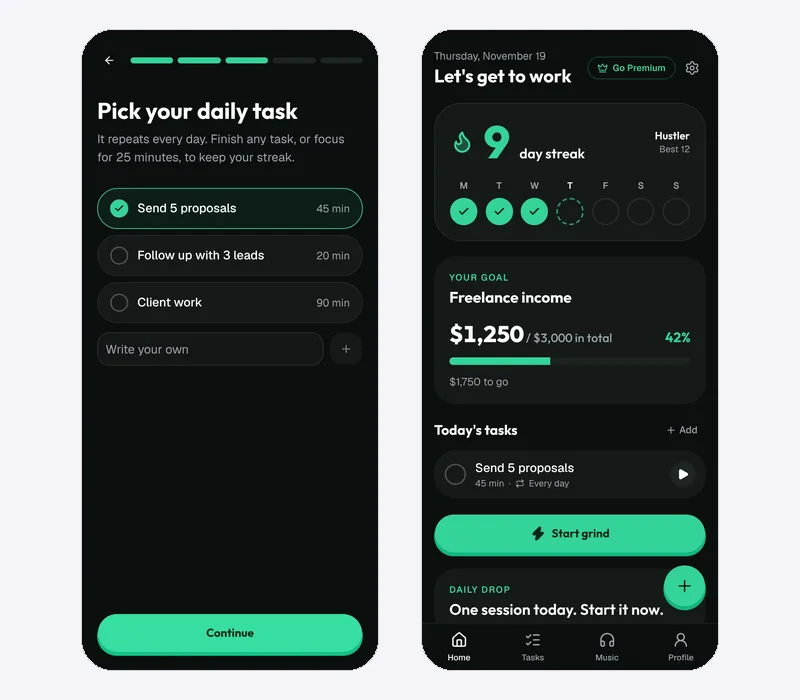
Write the "I will…" part of your stack as a recurring task, like "Send 5 proposals, 15 min". It shows up in today's list every day, with a play button that starts its timer. A grind day counts when you finish one task or focus for 25 minutes, so one stack a day keeps your streak going.
You can set your first money goal free and add your first stack as tonight's task. The free plan holds up to 3 open tasks at once, enough for a starter chain. When you build a longer routine, Premium removes that limit, and you can try it free for 14 days.
FAQ
What is an example of habit stacking?
"After I pour my morning coffee, I will write 5 lines of my next post." The coffee is the anchor you already do; the writing is the new habit. Anything you do daily at a fixed time can be an anchor.
How many habits should you stack at once?
Start with one. Add the next only when the first feels easy, which can take weeks. Short chains of two to four small steps work better than a long list.
Is habit stacking the same as implementation intentions?
They're close. An implementation intention is an if-then plan with a time and place. James Clear calls habit stacking a special form of it, where the time and place come from the current habit.
What if I keep forgetting my habit stack?
Your anchor is probably too vague or doesn't happen every day. Pick a clearer moment, put a visible cue at that spot (your laptop open on the table), and make the task smaller.
The short version
Pick an anchor that happens every day at the right place. Write one sentence: "After I [anchor], I will [small task]." Start with one stack, add a backup for odd days, and only add a second stack once the first feels easy.

Luiz King
Builds Money Mode, a habit tracker and focus timer made for the money grind.