
Does Lo-Fi Music Help You Focus? What Research Says

By Luiz King · · 7 min read

Lo-fi music can help you focus, but not by making you smarter. Research on background music finds no overall boost to performance. Music hurts reading and memory a little, and songs with lyrics hurt reading the most. Lo-fi has an edge because it's usually instrumental and steady. So use it for easy or hands-on work, and pick silence when you need to read, write or learn something new.
Below: what the studies actually found, which tasks suit lo-fi, and a two-week test to find out if it works for you.
What is lo-fi music?
Lo-fi ("low fidelity") is a style of slow, mellow beats, usually without vocals. It often has soft crackle or tape hiss on purpose. Think of the endless "beats to study to" livestreams.
What matters for focus is not the name. It's three traits most lo-fi tracks share: no lyrics, a steady tempo and few surprises. Keep those in mind, because they explain the research below.
What does the research say about music and focus?
Here are the main findings, from the biggest to the most specific.
| Study | What they tested | What they found |
|---|---|---|
| Kämpfe et al., 2011 (meta-analysis) | Background music vs no music, across many studies | No effect overall. Music disturbed reading and slightly hurt memory, but helped mood and sports |
| Sun et al., 2024 | Pop songs with lyrics while 90 students read | Reading scores were lower with lyrics than in silence, worst when lyrics were in the same language as the text |
| Orpella et al., 2025 | 4 sound types, including a "deep focus" lo-fi playlist, during a speed task (196 people) | Only "work flow" music improved both mood and speed. The lo-fi playlist didn't lift mood |
Why "no effect overall" doesn't mean music is useless
The meta-analysis authors say the null result is "most probably due to averaging out specific effects". In plain words: music helps some things and hurts others, and the average comes out near zero. It helped mood and workouts, and it got in the way of reading.
So the real question isn't "does music help?" It's "does music help this task?"
Lyrics are the problem, not music
Lyrics are words, and so is the text you're reading or writing. The two compete for the same attention. In the 2024 study, reading scores were lower with English pop than with silence, and lower still with Mandarin pop, the same language as the text.
Most lo-fi has no vocals, so it skips that clash. That's a real advantage over your normal playlist.
What about a study that tested lo-fi directly?
The 2025 PLOS ONE study is the closest we have. Researchers played four sounds to online volunteers during a six-minute task: "work flow" music, a "deep focus" playlist, pop hits and office noise. Georgetown University's write-up of the study says the deep focus tracks came from a Spotify playlist called "lofi", and the researchers were surprised it "did not positively impact mood".
Two honest caveats:
- The winning music had a sponsor. The paper says the work was funded by a grant from the company that made the "work flow" tracks, and two authors advise that company.
- The task was tiny. Six minutes of a simple reaction task is not two hours of client work.
So this study doesn't prove lo-fi is bad. It shows lo-fi isn't the magic the "study beats" label suggests.
When lo-fi helps, and when to pick silence
Put the research together and you get a simple rule. The more a task uses words, the more silence wins.
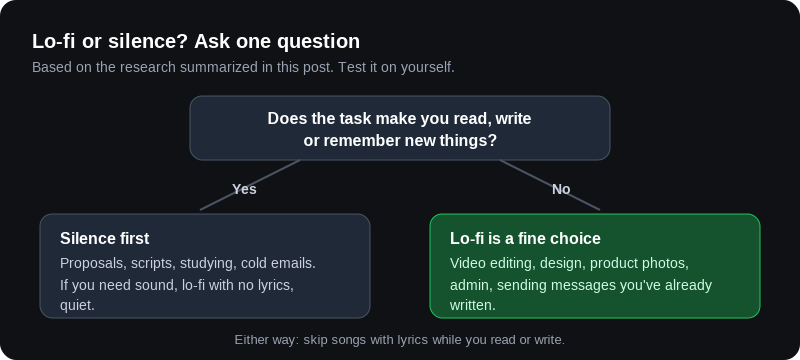
Here's how that plays out for common hustle work:
| Task | Lo-fi? | Why |
|---|---|---|
| Editing video, cutting clips | Yes | Hands-on work, few words |
| Design, thumbnails, product photos | Yes | Visual work, music won't compete |
| Admin, uploads, sending pre-written DMs | Yes | Easy, repeated work where mood helps |
| Writing proposals, scripts, emails | Silence, or very quiet lo-fi | Writing uses the same system as lyrics |
| Learning a new skill, reading docs | Silence | Music slightly hurts memory and reading |
Do you work in a noisy place? Some people use lo-fi to cover up noise they can't control, like a TV or a loud café. Research hasn't settled whether that beats the noise itself (in the 2025 study, Georgetown reports that office noise "did not have a measurable negative effect"), so treat it as a personal call.
Test it on yourself in two weeks
Studies give you averages. You're one person. So run a small test:
- Pick one task you repeat daily, like "send 5 proposals" or "edit 1 video".
- Swap every other day: lo-fi on day 1, silence on day 2, and so on, for 10 workdays.
- Use the same time block each day, for example 30 minutes.
- Write down one number after each block: proposals sent, minutes of video edited, pages done.
- Compare the two averages at the end, and how you felt.
| Day | Sound | Output (example) |
|---|---|---|
| Mon | Lo-fi | 4 proposals |
| Tue | Silence | 5 proposals |
| Wed | Lo-fi | 4 proposals |
| Thu | Silence | 5 proposals |
That table is an example, not real data. Your numbers might go the other way, and that's the point of testing.
How Money Mode plays lo-fi while you work
Money Mode is a free-to-start app for people making money online. You set a money goal, do one small task a day to keep your streak, and start a focus timer with one tap. It runs in your browser and installs on your phone like an app.
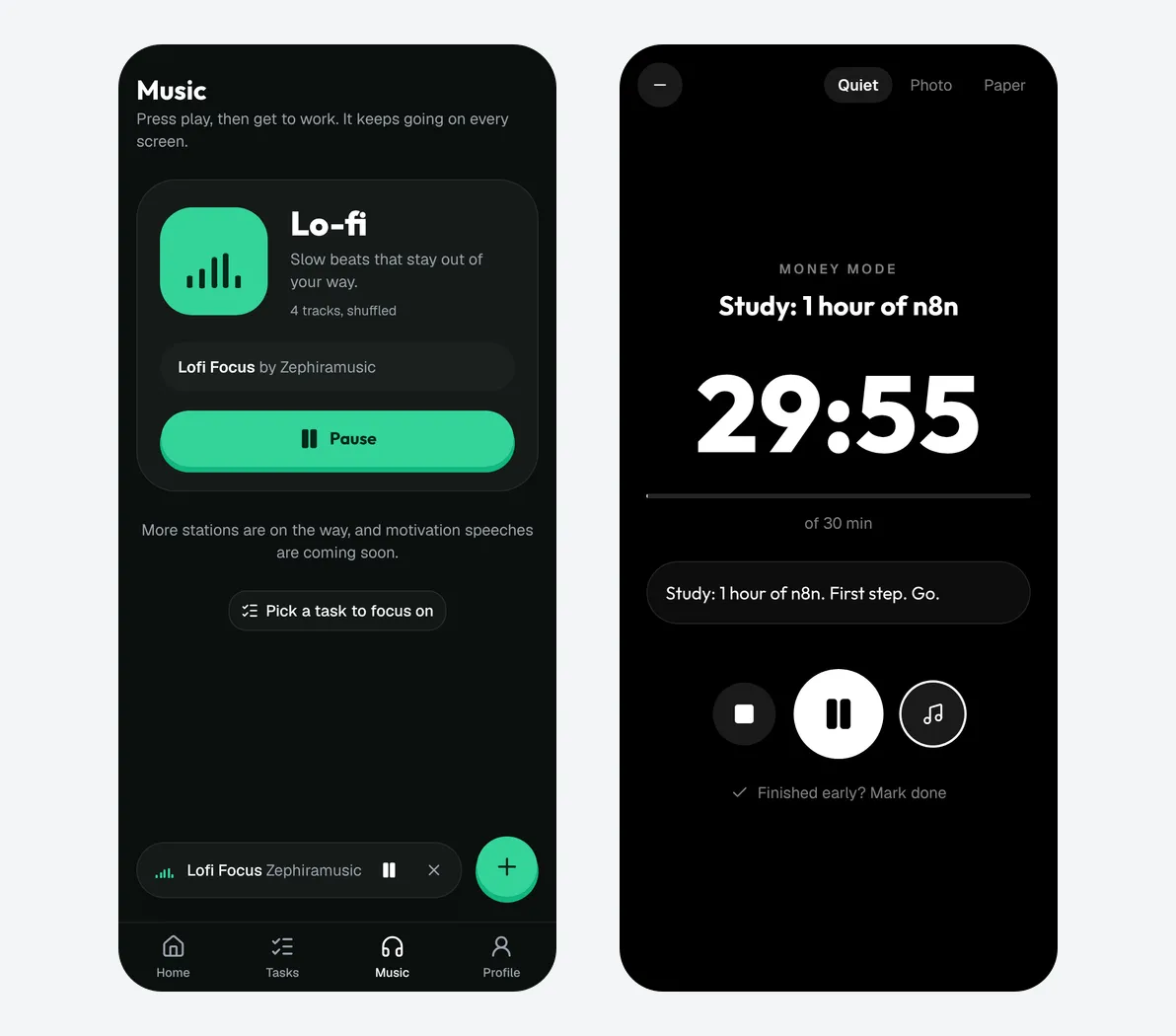
The music is built around the research above:
- You play a station, not songs. The Lo-fi station shuffles its tracks on its own, with no track list and no skip button, so there's nothing to fiddle with.
- Music and timer are separate. Start the timer in silence for writing days, or play Lo-fi for editing days. Pausing the timer doesn't stop the music.
- It keeps playing on every screen, so checking off a task doesn't cut the sound.
- Your focus minutes count. Focus 25 minutes or finish one task and the day counts toward your streak.
Lo-fi is the only station right now, and more are planned. You can set your first money goal free and run the two-week test with the timer and the Lo-fi station in one app.
FAQ
Is lo-fi good for studying?
It's fine for practice and hands-on work. For reading and memorizing, research points to silence: background music slightly hurts memory and disturbs reading.
Is it better to study in silence or with music?
Silence is safer for reading, writing and learning new things. Music, especially without lyrics, is fine for easy or hands-on tasks and can lift your mood.
Why does lo-fi help me focus?
It's usually instrumental and steady, so it doesn't compete with words the way lyrics do. Music also tends to lift mood, which can make a boring task easier to start.
Does music with lyrics hurt concentration?
For reading and writing, yes. In a 2024 study, reading scores were lower with pop songs than in silence, and lowest when the lyrics matched the language of the text.
The short version
Lo-fi isn't a focus hack, but it's one of the safer kinds of music to work to, because it has no lyrics and few surprises. Play it for editing, design and admin. Pick silence for writing, reading and learning. Then test it on yourself for two weeks and keep what your numbers say. If the real problem is distraction, see why Pomodoro might not be working for you or read what deep work really is.

Luiz King
Builds Money Mode, a habit tracker and focus timer made for the money grind.