
Lost Motivation After Making Money? Here's What's Going On

By Luiz King · · 7 min read

Losing motivation after making money is common, and it usually means one of three things: you hit your goal and never set a new one, your new goal is just "more" of the old one, or you're burned out. Each one has a different fix. The first two need a new goal that means something to you, with daily work attached. The third needs rest and less load, not a bigger target.
This post helps you work out which one you have, shows what research actually says about money and happiness, and gives you a simple way to set the next goal. One honest note: this is a motivation guide, not medical advice. If low mood lasts for weeks or affects your sleep, appetite or relationships, talk to a doctor or a mental health professional.
Why does motivation disappear after you make money?
Because for years, money was the goal. It told you what to do every morning: send the pitches, ship the product, close the deal. Once you have enough, that daily pull goes quiet.
People who've been there describe it the same way. One business owner who wrote in to 24/7 Wall St. said their success brought financial freedom but left them struggling with purpose and how to set new goals. On Indie Hackers, a founder asked what to do after building a successful business they'd come to hate.
The drive didn't break. It lost its target.
Which of the three is it?
Read each column and see which one sounds like you:
| Goal reached, no next goal | "More" of the same | Burnout | |
|---|---|---|---|
| How it feels | Bored, restless, a bit lost | "What's the point of another $10k?" | Tired all the time, even after rest |
| Small tasks feel | Easy but pointless | Fine, just flat | Huge, like chores |
| A week off would | Leave you itching to do something | Not change much | Help, at least for a while |
| Main fix | Set a new, specific goal | Change what you chase, not just the number | Cut load, delegate, rest |
What does research say about money and happiness?
Two studies are worth knowing, because they cut against both "money doesn't buy happiness" and "more money fixes everything".
More income tracks with more happiness for most people, but not everyone. In 2023, Matthew Killingsworth, Daniel Kahneman and Barbara Mellers published a study in PNAS of 33,391 employed US adults. For most people, happiness kept rising as income rose. But for the least happy group (roughly the unhappiest 15%), happiness stopped rising at about $100,000 a year. In plain words: if something else is making you unhappy, more money won't fix it past a point.
How you got the money matters. A 2018 study by Grant Donnelly, Michael Norton and colleagues surveyed more than 4,000 millionaires. More wealth was linked to more happiness only at high levels (above about $8 million in one sample and $10 million in the other), and the differences were modest. People who earned their wealth were somewhat happier than people who inherited it. Donnelly told PsyPost: "It appears that those who earned their wealth attach more happiness to it."
What this means for you: the earning was part of what made it feel good. The work, the progress and the wins mattered, not just the balance. So the fix is rarely to stop working. It's to find a new game worth playing.
If it's burnout: fix the load first
Don't set a bigger goal on top of an empty tank. A bigger target will make it worse. Instead:
- List everything you do in a week. Mark what only you can do.
- Hand off or drop one thing every week that isn't on that list.
- Take real time off. Not "a day off with my phone". A few days with no work apps.
- Shrink the daily target. One task a day, even 25 minutes, is enough to keep your hand in while you recover.
If you still feel exhausted after real rest, that's the point to talk to a professional.
If you need a new goal: how to choose one that works
A goal works when it's specific, a stretch but believable, and tied to something you care about beyond the number. "More money" fails all three. Here are kinds of next goals founders pick, with a daily input for each:
| Kind of goal | Example | Daily input |
|---|---|---|
| Freedom | Same income on 30 hours a week by June | 1 hour building systems to hand off work |
| Mastery | Ship a product you're proud of | 90 minutes of deep work on it |
| Scale | From $40k to $100k MRR | 1 sales conversation |
| New game | First $10k from a brand-new business | 1 hour on the new idea |
| Give back | Fund or mentor 5 people this year | 1 outreach or session a week |
Notice "new game" on the list. Many people get their spark back by starting at zero again on something new. It's the early, fast progress they missed, not the money.
Set your next goal in Money Mode
Money Mode is an app for people making money online. You set one money goal, do one small task a day to keep your streak, and start a focus timer with one tap. It runs in your browser and installs on your phone like an app.
It's built around one goal at a time, which fits this moment well. When you reach a goal, it moves to your Goals reached shelf on Profile, and you set the next one:
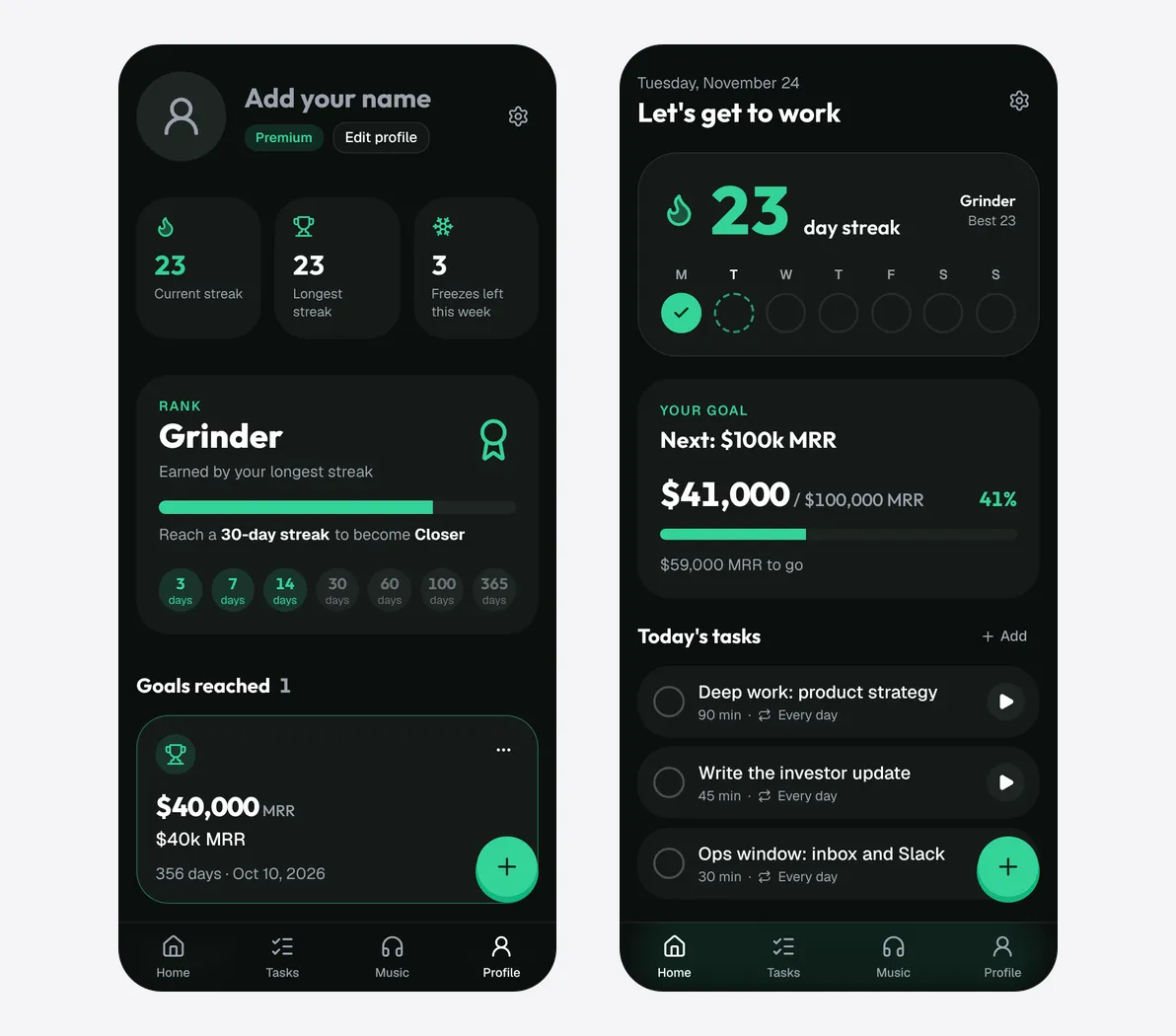
How it handles the switch:
- Reached goals stay visible. They sit on your Goals reached shelf, so the past wins don't disappear.
- MRR carries over. A new MRR goal starts from your current MRR, so growth counts from where you are.
- New daily tasks for the new game. Add the inputs from the table above as recurring tasks.
- A streak for showing up. One finished task, or 25 focus minutes, counts as a grind day.
It's free to start. Set your next goal free and give tomorrow morning a target again.
What not to do
- Don't quit everything on a bad month. Wait until you know whether it's burnout or the wrong goal.
- Don't just raise the number. Going from "$20k a month" to "$40k a month" with the same work rarely brings the spark back.
- Don't fill the gap with spending. New things feel good for a short while. They don't give you a reason to get up.
- Don't wait for motivation to return on its own. Motivation often follows action. Our post on motivation vs discipline explains why.
FAQ
Is it normal to lose motivation after reaching a financial goal?
Yes. When money was the main thing driving your daily work, reaching it removes that pull. People in this spot often describe it as losing purpose, not losing ability.
Does making more money make you happier?
For most people, happiness keeps rising with income, according to a 2023 PNAS study of 33,391 US adults. For the least happy group, it stopped rising at about $100,000 a year. Among millionaires, those who earned their money were somewhat happier than those who inherited it.
How do I find motivation again after success?
Work out whether it's burnout or a missing goal first. If it's a missing goal, set a specific new one with a date, attach a daily task to it, and track progress. If it's burnout, reduce load and rest before setting any new target.
Should I sell my business if I've lost motivation?
Not in the first month. Take real time off, then ask whether a different role in the business (or a new goal for it) would bring the energy back. If neither does after a few months, selling is worth a serious look. Talk to an advisor before deciding.
The short version
Losing motivation after making money doesn't mean something's wrong with you. Usually the goal is done and nothing has replaced it. If you're exhausted, fix the load first. If you're restless, pick a new goal with a number, a date and a reason you care about, then attach one daily task to it. The spark comes back with progress, not with rest alone.

Luiz King
Builds Money Mode, a habit tracker and focus timer made for the money grind.