
Dropshipping Daily Routine: What to Do Every Day

By Luiz King · · 7 min read
A good dropshipping daily routine has three parts. First, keep customers happy: check orders, tracking and support messages. Second, grow: test one product or one ad idea. Third, check your numbers without touching ads that are still learning. Everything else, like supplier reviews and store design, belongs in a weekly slot, not your daily one.
Here's the routine, with times, plus the two rules most beginners learn the hard way.
What does a dropshipping store owner do every day?
First, a quick definition. Shopify describes dropshipping as "a retail fulfillment method that involves selling products without buying inventory". When you make a sale, you forward the order to a supplier, who ships it straight to the customer (Shopify).
So you never touch the product. Your job is everything around it: finding products, marketing them, and handling customers when shipping goes wrong. That's what the daily routine has to cover.
The daily routine (about 2 hours)
This example fits a part-time store run next to a day job. Full-time sellers do the same blocks, just with a longer growth block.
| Block | Time | What you do |
|---|---|---|
| 1. Orders and support | 30 min | Check new orders went to the supplier, look for stuck tracking, answer every support message |
| 2. Growth | 60 min | Test 1 product or make 1 new ad creative (one, not both) |
| 3. Numbers | 15 min | Check sales, ad spend and cost per purchase. Write them down. |
| 4. Tomorrow | 5 min | Pick tomorrow's one growth task |
Block 1: Orders and support come first
Shipping problems turn into refunds and chargebacks (when a customer asks their bank to reverse a payment). Catching them early is cheaper than fixing them late. Every day:
- Confirm yesterday's orders reached the supplier.
- Look for orders with no tracking update in several days.
- Reply to every customer message, even if it's only "I'm checking with the supplier and will update you tomorrow."
Block 2: One growth task, not five
This is where beginners burn out. They try to find products, edit the store, make ads and watch YouTube tutorials in one evening, and finish nothing.
Pick one:
- Product test day: research and list one product with a real product page.
- Creative day: make one new ad video or image for a product you're already testing.
One finished test teaches you more than five half-built ones.
Block 3: Check numbers, don't panic-edit
Look at your numbers daily, but don't change your ads daily. The next section explains why.
Rule 1: Don't edit ads while they're learning
When you launch or change a Meta (Facebook and Instagram) ad set, it goes through a learning phase: the system tests who to show it to. Meta's guidance is that an ad set needs around 50 optimization events within 7 days to leave that phase (Meta Business Help Center; Meta for Developers). An optimization event is the result you told Meta to aim for, such as a purchase.
Meta also says that significant edits, like changing the audience, the creative or the optimization event, or pausing the ad set, can send it back into learning (Meta: Last significant edit).
So editing an ad every morning because yesterday was bad can keep it learning forever. Check daily, but make changes on a set day, unless something is clearly broken.
Rule 2: Know the shipping-time law
If you sell to US customers, the FTC's Mail, Internet, or Telephone Order Merchandise Rule applies to online orders too. In plain words (FTC business guide):
- You must have a reasonable basis for any shipping time you advertise.
- If you don't state a time, you must reasonably expect to ship within 30 days.
- If you can't ship on time, you must ask the customer to agree to the delay. If they don't agree, you must refund them promptly, without being asked.
Slow suppliers are common in dropshipping, so this matters. Only promise shipping times your supplier actually meets, and put "check for delays" into your daily block 1. This is general information, not legal advice. Rules differ by country, so check the ones where you sell.
What to do weekly, not daily
Moving these out of the daily routine frees up your evenings:
| Task | How often |
|---|---|
| Make ad changes (budget, audience, creative swaps) | 1–2 set days a week |
| Review supplier shipping times and stock | Weekly |
| Kill or keep product tests | Weekly, based on your numbers |
| Store design and new pages | Weekly or monthly |
| Totals: revenue, ad spend, profit | Weekly |
How many hours a day does dropshipping take?
As many as your goal needs, but the routine above works on 2 hours a day. With a day job, 1 to 2 focused hours on most days is realistic. (Here's how to work out your side hustle hours.) Full-time sellers spend the extra time on more product tests and more creatives, not on more checking.
Want to know how long your goal could take? Put your average order profit, the store visits it takes to make a sale and your weekly visits into the free money goal calculator. It shows the math, not a promise.
How Money Mode keeps the routine on track
Money Mode is a free-to-start app for people making money online. You set a money goal, do one small task a day to keep your streak, and start a focus timer with one tap. It runs in your browser and installs on your phone like an app.
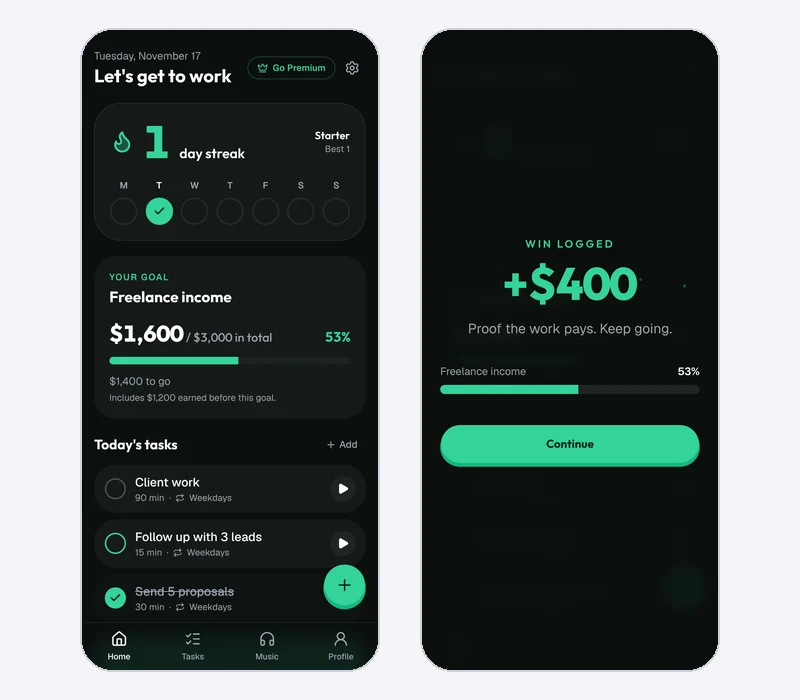
When you pick e-commerce during setup, Money Mode suggests a $5,000 store revenue goal and daily tasks like "Test 1 product", "Launch 1 ad" and "Answer all support tickets". Those match the blocks above. Press play on a task and its timer starts, and log revenue when it comes in to watch the goal bar move.
Set your first money goal free and add your support block as the first task. The free plan allows 3 open tasks at once, which covers this routine. If you add more daily tasks or want your history and data synced across devices, Premium covers that, with a 14-day free trial.
FAQ
What should a dropshipping beginner do every day?
Check orders and answer every support message first. Then do one growth task: test one product or make one ad creative. End by writing down your sales, ad spend and cost per purchase.
How many products should I test per week?
Test as many as you can give a fair test, not as many as you can list. A product needs real traffic before you judge it. For most part-time sellers, one or two proper tests a week is plenty.
Should I change my Facebook ads every day?
Usually not. Meta says ad sets need around 50 optimization events in 7 days to leave the learning phase, and significant edits can restart learning. Check daily, but change ads on set days.
Can I run a dropshipping store with a full-time job?
Yes, if you keep the daily part small: about 30 minutes of orders and support plus one growth task. Save ad changes and supplier reviews for weekly slots, and pick suppliers with reliable shipping so support doesn't eat your evenings.
The short version
Customers first, one growth task second, numbers last. Check ads daily but edit them on set days, and only promise shipping times your supplier can keep. A small routine you do every day beats a big one you do once a week.

Luiz King
Builds Money Mode, a habit tracker and focus timer made for the money grind.